The Complete Buyer’s Guide to Commercial Shade Structures in Georgia: Costs, Codes, and What Nobody Tells You
Anyone who has managed an outdoor commercial space in Georgia knows that the climate is not forgiving. From April through October, sustained heat and direct sun exposure create real problems for businesses that depend on outdoor usability — whether that is a school campus, a municipal park, a hospitality venue, or a retail parking area. The question is rarely whether shade coverage is needed. The question is what kind, at what cost, and under what conditions it will hold up year after year.
Making a sound purchasing decision for a permanent or semi-permanent shade structure involves more than choosing a color and a fabric. It involves understanding local permitting obligations, material performance over time, installation timing, and the less-discussed realities of maintenance and liability. This guide addresses all of those areas plainly, without shortcuts.
Why Georgia’s Climate and Jurisdiction Make Shade Structure Decisions More Complex
Georgia’s geography creates a specific combination of conditions that affects structure selection in ways that buyers from other regions do not always anticipate. The state sees high summer heat and humidity, periodic wind events associated with coastal storm systems, UV intensity that degrades certain materials faster than manufacturer timelines suggest, and rainfall patterns that vary significantly between coastal, piedmont, and mountain regions. Buyers who approach shade structure procurement as a straightforward purchasing decision often find themselves revisiting the decision within a few years when materials degrade prematurely or structures fail inspection during a project expansion.
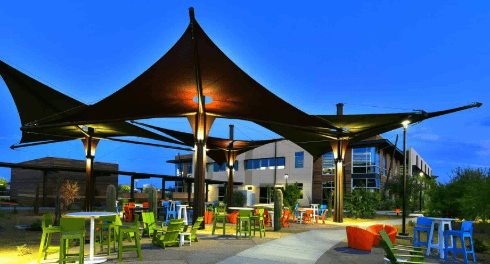
For anyone researching commercial shade structures in georgia, the range of available products, contractors, and structural approaches can appear wider than it actually is once local code requirements and climate-specific performance standards are factored in.
What most buyers do not discover until they are mid-project is that shade structures in Georgia often fall under the jurisdiction of local building departments, not just the manufacturer’s installation guidelines. This distinction matters because a structure that is code-compliant in one county may require additional engineering documentation, wind load calculations, or foundation specifications in another.
Local Permitting Is Not Optional for Most Permanent Installations
The assumption that a shade structure is a minor outdoor accessory — and therefore exempt from formal permitting — is one of the most common and costly mistakes commercial buyers make. In Georgia, permanent shade structures that are attached to a building, exceed a certain square footage, or are anchored with concrete footings typically require a building permit. The threshold varies by county and municipality, but the default assumption should be that any structure intended to remain in place longer than a few months will require documentation.
What this means practically is that the buying process should begin with a conversation with the local building department before any contractor is engaged. Some jurisdictions require stamped engineering drawings. Others require specific foundation designs based on soil conditions. Coastal counties near Savannah or Brunswick apply different wind load requirements than inland counties near Atlanta or Macon, and these requirements directly affect both material selection and structural engineering costs.
Wind and UV Ratings Are Not Standardized Across Manufacturers
When a manufacturer states that a product is rated for a certain wind speed or that fabric will retain its structural integrity for a set number of years, those claims are often based on controlled testing conditions that do not reflect real-world installation environments. Georgia’s coastal and transitional climate zones introduce variables — sustained humidity, thermal cycling, and UV exposure — that accelerate material degradation in ways that lab testing may not fully capture.
Buyers should ask contractors and manufacturers to provide documentation of real installations in comparable climate zones, not just technical specifications from a product sheet. The difference between a shade sail that maintains tension and UV blocking after five years in coastal Georgia versus one installed in a drier inland climate is not trivial. It affects the total cost of ownership significantly.
Understanding the True Cost Structure Before Committing
Commercial shade structures are often priced and quoted in ways that obscure the full cost of ownership. The initial material and installation quote is rarely the complete picture. Buyers who evaluate proposals based on upfront cost alone consistently underestimate what they will spend over a five- to ten-year horizon.
What the Quote Usually Does Not Include
Standard contractor proposals for commercial shade structures typically cover the cost of the structure itself, primary materials, and basic installation labor. What they frequently exclude — sometimes by omission, sometimes because buyers do not ask — includes permitting fees, engineering stamp costs if required, site preparation such as grading or concrete work beyond standard footings, and annual maintenance or seasonal adjustment services.
For buyers managing public facilities or institutional properties, there is also the question of compliance documentation. Some insurance carriers and public liability frameworks require that installed structures have documented inspection histories, particularly for playgrounds, aquatic facilities, and school campuses. This ongoing documentation requirement is an operational cost that should be built into the total budget from the beginning.
Material Selection and Long-Term Cost Are Directly Connected
The primary structural materials used in commercial shade applications — typically steel, aluminum, or galvanized steel — carry very different long-term maintenance profiles. Steel offers load-bearing strength but is vulnerable to surface corrosion in humid environments if not properly coated and maintained. Aluminum is corrosion-resistant but may not carry the load requirements of larger span structures. Galvanized options offer a middle path but still require periodic inspection and touch-up in high-moisture environments.
Shade fabric selection is equally consequential. High-density polyethylene fabrics remain the most common choice for commercial applications because of their UV blocking capacity and relative durability, but fabric tension, anchoring method, and drainage design all affect how long a fabric canopy performs before it requires replacement. A fabric canopy that pools water or maintains inadequate tension will degrade significantly faster than one that is correctly sized, tensioned, and drained.
The Permitting and Code Compliance Process in Practice
Georgia does not operate under a single statewide building code for shade structures. Local jurisdictions adopt and amend the International Building Code and related standards independently, which creates meaningful variation across the state. The International Building Code provides the base framework that most Georgia counties reference, but local amendments, particularly around wind load and foundation requirements, are common and not always easy to access without a direct conversation with the local authority.
How to Approach the Permit Process Without Delaying Your Project
The permit process adds time to any installation project, but the delay is almost always manageable when the process is started early and the documentation is prepared correctly the first time. Buyers who attempt to begin installation before permitting is complete — or who assume that a contractor is handling permitting without confirming it — frequently encounter stop-work orders, fines, or the requirement to modify or remove already-installed components.
The most efficient approach is to engage a contractor who has documented experience pulling permits for commercial shade installations specifically in the county or municipality where the project is located. Contractors who are familiar with local plan examiners, who know which engineering firms the jurisdiction accepts, and who understand the typical timeline for review in that jurisdiction will save significant time compared to contractors who are competent in installation but unfamiliar with local administrative processes.
See also: Maximizing Business Success Through Digital Marketing
Site Conditions That Affect Installation More Than Most Buyers Realize
The physical conditions of the installation site have a direct and measurable impact on both project cost and long-term structure performance. Sites with shallow topsoil, expansive clay, or subsurface rock require different foundation approaches than standard soil conditions, and these requirements are not always apparent until a contractor conducts a proper site assessment.
Drainage, Grade, and Surrounding Infrastructure
Shade structures installed over paved surfaces, playground equipment, or outdoor seating areas must account for how water is shed from the canopy and where it goes. Inadequately designed drainage can result in water pooling on the canopy itself, which increases fabric stress and accelerates wear. It can also direct runoff toward building foundations, electrical infrastructure, or pedestrian pathways in ways that create both maintenance problems and liability exposure.
Grade changes across the installation footprint affect post height requirements and the engineering of the overall structure. A site that appears level may have a grade differential that requires one post to be significantly taller than others to maintain a consistent canopy angle. These adjustments affect the structural calculations, the material order, and ultimately the cost of the project.
Maintenance Requirements and What Happens When They Are Ignored
Commercial shade structures in Georgia are not install-and-forget infrastructure. The combination of UV exposure, seasonal storm activity, biological growth from humidity, and mechanical stress from wind loading means that annual inspection and periodic maintenance are necessary to sustain both performance and safety.
Common Maintenance Failures and Their Consequences
The most frequent maintenance failures in commercial shade installations involve fabric tension loss, hardware corrosion at connection points, and accumulation of organic material on canopy surfaces. Tension loss is gradual and often goes unnoticed until the fabric begins to flap in wind or pool water after rain. Left unaddressed, tension loss accelerates wear at anchor points and can eventually cause structural failure during a wind event.
Hardware corrosion at bolt connections, post bases, and anchor plates is particularly problematic in Georgia’s coastal zones and in areas with high ambient humidity. Corrosion compromises the load capacity of connection points without necessarily being visible from a distance, which is why ground-level visual inspections are insufficient for structures that see regular public use.
• Annual inspection of all hardware connection points, including anchor bolts and post base plates, should be documented and retained for liability purposes.
• Fabric tension should be assessed after major storm events, not just on a fixed annual schedule.
• Canopy surfaces should be cleared of leaf and debris accumulation before wet seasons to prevent biological growth and additional weight loading.
• Any visible cracking, fraying, or discoloration of fabric should be evaluated by the original installer or a qualified inspector before the structure sees heavy use.
Closing Considerations for Georgia Buyers
Purchasing commercial shade structures in Georgia is a decision that carries long-term operational and financial implications that extend well beyond the initial installation. The buyers who consistently achieve the best outcomes are those who begin the process with a clear understanding of their site conditions, engage with local permitting authorities before selecting a contractor, and build maintenance obligations into their facility management plans from day one.
The market for commercial shade structures in georgia includes contractors and suppliers with very different levels of experience with local code requirements, climate-specific material performance, and institutional accountability. Verifying contractor experience with comparable local projects, requesting references from completed installations in similar Georgia climate zones, and confirming that all permitting and engineering documentation is in order before any work begins are not optional steps — they are the difference between a structure that performs reliably for its intended lifespan and one that creates ongoing cost and liability exposure.
For facilities managers, municipal administrators, school districts, and commercial property owners, the investment in a properly specified, permitted, and maintained shade structure is straightforward to justify. The investment in a structure that was selected primarily on price, without accounting for local conditions and compliance requirements, rarely holds up to scrutiny once real-world performance is measured against initial expectations.