How to Choose a Commercial Landscaping Company in the US: A No-Fluff Buyer’s Guide
For property managers, facility directors, and business owners responsible for multi-site or large-footprint properties, maintaining the exterior environment is a recurring operational responsibility — not a one-time project. The grounds surrounding a commercial property affect first impressions, comply with local ordinances, support safety requirements, and reflect directly on the organization that occupies the space. When that maintenance is inconsistent or poorly executed, the downstream effects extend well beyond appearance.
Selecting an outside vendor for this work is a decision that carries real operational weight. The wrong choice often means unreliable scheduling, high turnover of crew members, inconsistent output across seasons, and the administrative burden of constant follow-up. The right choice, by contrast, means predictable service, clear communication, and a vendor that functions as an extension of your facilities team rather than a source of friction.
This guide is written for professionals in the process of evaluating providers. It covers the criteria that matter, the questions worth asking, and the operational details that separate capable vendors from those who simply show up with equipment.
What Commercial Landscaping Actually Involves at Scale
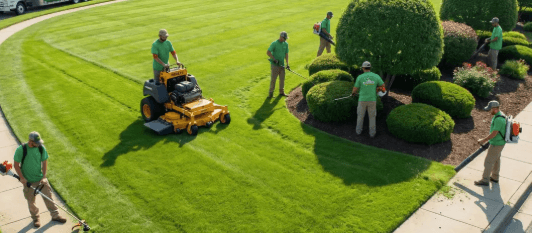
When organizations search for commercial landscaping services, the scope of work they need is often broader than routine mowing and edging. At a commercial level, grounds maintenance encompasses seasonal transitions, irrigation management, mulching, turf health programs, snow and ice removal in relevant climates, and the long-term care of trees, shrubs, and planted beds. Each of these tasks carries its own scheduling requirements, equipment demands, and expertise thresholds.
The distinction between residential and commercial work is not merely one of scale. Commercial properties typically involve more complex site logistics — multiple access points, pedestrian traffic patterns, active business hours that constrain when work can be performed, and regulatory requirements tied to water usage, chemical applications, or right-of-way maintenance. A provider with primarily residential experience may not have the crew structure, equipment capacity, or scheduling discipline that a commercial account requires.
Scope Definition Before Vendor Selection
Before evaluating any vendor, the property manager or facilities decision-maker should have a documented understanding of what the property actually needs. This means walking the site and identifying the specific maintenance tasks required by zone — which areas are high-visibility and need more frequent attention, which areas are functional rather than aesthetic, and which seasonal services are non-negotiable versus optional.
Without this internal clarity, it becomes difficult to compare vendor proposals on equal terms. Two proposals for the same property can differ dramatically in what they include or exclude. One vendor may price at a lower rate by omitting bed maintenance, fertilization cycles, or cleanup visits that another vendor assumes as standard. The result is either a misleading cost comparison or a contract that requires constant amendments once service begins.
How to Evaluate a Vendor’s Operational Reliability
Operational reliability in grounds maintenance means that the agreed schedule is followed consistently, that service quality does not degrade over time, and that the vendor communicates proactively when conditions — weather, staffing, or equipment issues — require a change. This is the dimension of performance that causes the most friction when it breaks down, and it is also the hardest to assess during a proposal process.
Reliability is a function of how a company is structured internally, not just how they present externally. A provider that uses a rotating pool of subcontractors will naturally produce more variability than one with full-time, trained crew members assigned to specific account routes. Similarly, a provider that relies on a single point of contact for communication introduces risk whenever that person is unavailable.
Crew Stability and Account Assignment Practices
One of the most useful questions to ask a prospective vendor is how they assign crews to commercial accounts. Some companies assign dedicated crews — the same team visits the same properties on each service cycle. Others operate with a centralized dispatch model where crew composition may shift depending on staffing availability on any given day. Each model has trade-offs, but for large or complex properties, dedicated assignment generally produces more consistent results because the crew develops familiarity with the site over time.
Crew stability also reflects the vendor’s internal employment practices. High turnover in the field almost always produces inconsistent service quality. It is reasonable to ask a vendor directly about average tenure for field staff and whether seasonal fluctuations affect their full-time crew count. Vendors who can answer these questions clearly are generally better organized than those who deflect or generalize.
Communication Structures and Account Management
Beyond crew performance, the administrative relationship with a vendor matters considerably. Property managers at large organizations often manage multiple vendors across multiple sites. The overhead of managing a landscaping vendor should be low — confirmation of service visits, notification of any issues found on site, documentation of treatments applied, and clear escalation paths when something needs to be addressed.
Vendors that operate without formal account management structures tend to require more effort from their clients. Identifying whether a potential vendor assigns a dedicated account manager, provides service logs, and uses a client-facing platform for communication is a practical step that affects day-to-day workflow once a contract is in place.
See also: Creative Home Improvement Ideas to Make Small Spaces Look Bigger
Licensing, Insurance, and Compliance Requirements
In the United States, the licensing and certification requirements for commercial grounds maintenance vary by state and by the type of work being performed. Pesticide and herbicide applications, for example, are regulated at the state level and require licensed applicators under the Federal Insecticide, Fungicide, and Rodenticide Act, which is administered by the U.S. Environmental Protection Agency in coordination with state agencies. Any vendor applying chemical treatments to your property without the appropriate licensing creates liability exposure for the property owner, not just the vendor.
General liability insurance and workers’ compensation coverage are baseline requirements for any legitimate commercial vendor. The coverage amounts should reflect the scale of the work and the value of the property involved. It is standard practice to request certificates of insurance before a contract is executed and to ensure that your organization is listed as an additional insured where applicable.
Verifying Compliance in Practice
Asking for proof of licensing and insurance is straightforward. What requires more attention is verifying that coverage is current and that the documentation provided reflects the actual scope of the vendor’s work. Some providers carry minimum coverage that may not be sufficient for large commercial properties or for services like tree removal, which carries a higher risk profile.
It is also worth confirming whether the vendor uses subcontractors for any portion of the work and whether those subcontractors carry their own coverage or operate under the primary vendor’s policy. Gaps in this area are a common source of liability disputes after incidents on site.
Contract Structure and Service Agreements
The structure of a service agreement directly affects how well the relationship functions over time. Vague or loosely defined contracts lead to disputes about what is and is not included, and they make it difficult to hold a vendor accountable when performance falls short. A well-constructed service agreement should specify the frequency of each service type, the standards against which work will be evaluated, the process for requesting additional services, and the terms under which either party may terminate or renegotiate.
Seasonal Flexibility and Change Management
Commercial properties often require adjustments to service plans as conditions change. A property that adds new planted areas, installs irrigation, or undergoes construction needs a vendor who can accommodate those changes within the contract framework without requiring full renegotiation. Understanding how a vendor handles scope changes — their pricing methodology, lead time expectations, and approval process — is a practical consideration that affects the ongoing relationship.
Annual contracts with defined renewal terms are common in this industry, but some organizations benefit from multi-year agreements with performance benchmarks built in. This structure can reduce the administrative burden of annual bidding while giving the property owner clear grounds for contract review if service quality declines.
Cost Benchmarking and Budget Planning
The cost of commercial grounds maintenance varies considerably based on property size, service frequency, regional labor markets, and the specific mix of services required. Rather than approaching the vendor selection process with a fixed budget and selecting whoever fits within it, a more effective approach is to gather two or three detailed proposals, ensure they are based on identical scopes of work, and then evaluate them against the operational factors outlined above.
The lowest bid in a competitive process is not automatically the best value. A vendor that prices aggressively to win the contract and then reduces service frequency or crew time to maintain margin is a common outcome in this industry. Evaluating cost in the context of the vendor’s crew model, communication practices, and track record with comparable accounts gives a more accurate picture of what a contract will actually deliver.
Closing Considerations for the Selection Process
Choosing a grounds maintenance partner for a commercial property is a decision that plays out over months and years, not days. The evaluation criteria that matter most — reliability, crew stability, clear communication, proper licensing, and a well-structured contract — are not visible in a proposal document alone. They emerge through reference conversations with existing clients, direct questions about internal operations, and careful review of how a vendor documents and manages their work.
Organizations that treat this selection process as a procurement exercise focused primarily on unit pricing tend to encounter the same problems repeatedly: inconsistent service, administrative burden, and the cost of transitioning vendors more frequently than necessary. Those that take a more thorough approach — defining their scope clearly, asking operationally grounded questions, and verifying credentials independently — tend to build vendor relationships that hold up across seasons and property changes.
The goal is not to find the cheapest provider or the one with the most polished presentation. It is to find a company with the internal structure and professional discipline to deliver consistent results on a schedule your operation can rely on. That standard, applied consistently through the evaluation process, is what separates a successful vendor relationship from one that creates more work than it solves.