
Wire Saw vs. Gigli Saw Blade: A Surgeon’s Practical Guide to Choosing the Right Tool
In surgical environments where bone must be cut with precision and minimal tissue disruption, the choice of cutting instrument is rarely straightforward. Surgeons working across orthopedic, neurosurgical, and reconstructive disciplines frequently encounter situations where the standard oscillating or reciprocating power saw is not appropriate — either because of anatomical constraints, procedural risk, or the need for controlled manual cutting. In those moments, the decision often narrows to two tools: the wire saw and the gigli saw blade.
Both instruments have long histories in surgical practice. Both are designed for cutting bone in confined or difficult-access situations. But they behave differently, suit different anatomical scenarios, and carry distinct risk profiles. The wrong choice does not just complicate a procedure — it can extend operative time, compromise surrounding tissue, and introduce errors that are difficult to correct mid-surgery. Understanding the practical differences between these two instruments is not an academic exercise. It is a clinical judgment that affects outcomes.
What the Gigli Saw Blade Actually Is and How It Works
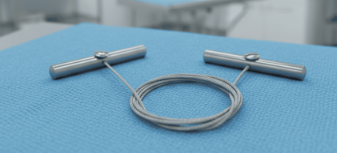
The gigli saw blade is a flexible, twisted wire with sharp cutting edges along its length. It was originally developed in the late nineteenth century by Italian gynecologist Leonardo Gigli as a tool for symphysiotomy — the cutting of the pubic symphysis during obstructed labor. Over time, its application expanded across surgical specialties, particularly in orthopedic and neurosurgical procedures where controlled manual bone cutting is required in tight anatomical spaces.
The blade works by being passed around or beneath a bone and pulled back and forth in a sawing motion using handle attachments at each end. The cutting action is distributed across the entire length of the blade in contact with the bone, which allows the surgeon to maintain directional control without the torque associated with powered instruments. Because the blade is flexible, it conforms to the geometry of the bone being cut rather than imposing a fixed cutting path.
The Structural Design and What It Means Operationally
The twisted wire construction of the gigli saw blade creates a self-clearing cutting surface. As bone material is removed, the grooves in the wire carry debris away from the cut zone. This reduces heat buildup at the cut site and helps maintain consistent cutting efficiency throughout the procedure. In contrast to flat or toothed blades that can bind or clog, the gigli’s design makes it particularly well-suited to sustained cuts through dense cortical bone.
The handles used with the blade also matter more than they might appear. Ergonomic handle placement determines the angle of tension applied to the blade, and inconsistent tension — even slightly — can cause the blade to drift or bow. Surgeons using this instrument need to maintain balanced, rhythmic pull on both handles to keep the cut true. It is a technique-dependent tool, and experience with it substantially affects the quality of the cut.
See also: Building a Scalable Telehealth Practice: Operational Essentials
Procedure Types Where the Gigli Saw Blade Is Preferred
Certain surgical scenarios consistently favor the gigli saw blade over powered or rigid alternatives. These include:
• Craniotomy procedures where the blade can be passed through a burr hole and drawn across the skull plate with controlled manual tension, minimizing the risk of dural damage that a powered saw might introduce.
• Limb amputation surgeries where surgeons need to make a clean transverse cut through long bone in conditions where powered equipment is unavailable or impractical.
• Reconstructive osteotomies where the bone geometry makes access with a powered instrument difficult and where a flexible cutting surface offers a more predictable result.
• Field or austere surgical environments where simplicity, portability, and absence of power dependency are operational requirements.
The Wire Saw and How It Differs From the Gigli Design
The term “wire saw” is broader and is applied to several instrument types that share the characteristic of using a continuous or looped wire strand as the cutting medium. In surgical contexts, wire saws are sometimes constructed from braided or twisted steel wire similar in appearance to the gigli saw, but they differ in several important respects — including wire diameter, abrasive coating, tooth orientation, and handle configuration. Outside of surgery, wire saws appear across industrial, rescue, and construction applications, which occasionally causes confusion when the term is used without qualification.
In the surgical setting, wire saws designed for bone cutting may feature abrasive diamond coatings or differently configured cutting edges compared to the gigli blade’s distinctive twisted construction. Some wire saw designs are intended for use with mechanical tension frames rather than manual pulling, which changes the handling characteristic significantly. The distinction matters because it affects how much tactile feedback the surgeon receives and how precisely the cut can be guided.
Tactile Feedback and Surgeon Control
One of the most practically significant differences between a standard wire saw and a gigli saw blade lies in tactile feedback. When a surgeon uses a gigli blade manually with handle attachments, the resistance transmitted through the handles reflects exactly what is happening at the cut site. Changes in bone density, the approach of the medullary cavity, or blade binding all register as changes in pull resistance. This real-time feedback is a genuine safety mechanism.
Some wire saw configurations, particularly those using mechanical frames or guided tension systems, reduce or eliminate this direct feedback. The cut proceeds more uniformly in mechanical terms, but the surgeon has less immediate awareness of what is happening beneath the surface. For procedures where bone anatomy is predictable and well-imaged preoperatively, this may be acceptable. In cases where intraoperative conditions may differ from what imaging suggested, the loss of tactile information carries real risk.
Durability and Single-Use Considerations
Wire saws and gigli saw blades share a common limitation: both are subject to fatigue along the wire length with repeated use. Wire that has been stressed through multiple cutting cycles may develop micro-fractures that are not visible to the naked eye. A blade failure mid-procedure creates a serious complication — retrieving a broken fragment from a surgical site is time-consuming and can cause additional tissue trauma.
For this reason, both instrument types are generally treated as single-use devices in modern surgical practice, consistent with guidance from infection control and device safety frameworks maintained by bodies such as the U.S. Food and Drug Administration on surgical device integrity and sterility. The cost implication is real, but the alternative — reprocessing a wire cutting instrument — introduces both sterility risk and the possibility of using a structurally compromised blade.
Making the Decision: Key Factors That Should Guide Tool Selection
The choice between a wire saw and a gigli saw blade in a surgical context is not primarily a question of preference. It is a function of the procedure, the anatomical site, the available assistance, and the surgeon’s familiarity with each instrument. Defaulting to whichever tool is most familiar, rather than most appropriate, is a pattern that experienced surgical teams try to avoid.
Access and Anatomical Geometry
If the procedure requires the cutting instrument to be passed through a narrow channel, around a curved bone surface, or in a space where powered instruments cannot safely operate, the gigli saw blade’s flexibility is a structural advantage. It can be positioned in ways that rigid instruments cannot. This is not a minor consideration in procedures like posterior spinal surgery, pelvic osteotomy, or any approach where surrounding soft tissue must be protected from inadvertent contact with a cutting edge.
Wire saws in their broader configurations may be less well-suited to these constrained approaches, particularly if their handle or frame design requires more clearance than the anatomy allows. Surgeons planning complex access routes should assess instrument geometry before the procedure rather than adapting intraoperatively.
Assistance and Technique Requirements
Using a gigli saw blade effectively typically requires a two-handed technique, and in practice, a surgical assistant is often needed to maintain retraction and tissue protection while the primary surgeon operates the blade handles. Wire saw systems that use mechanical frames may allow a single operator to manage the cutting process, but they introduce different setup and positioning demands.
This practical consideration — who is available, and what their role requires — should factor into instrument selection. A technically superior instrument that requires an additional skilled pair of hands to operate safely is not always the right choice in a constrained team environment.
Conclusion: The Right Tool Is the One You Can Use Well
Comparing wire saws and gigli saw blades is not a question of which instrument is objectively better. Both have earned their place in surgical practice through demonstrated reliability in specific situations. The relevant question is which instrument best matches the procedure, the anatomical constraints, the team configuration, and the surgeon’s depth of experience with each tool.
The gigli saw blade offers flexibility, tactile feedback, and an established track record in tight anatomical access scenarios. Wire saw configurations offer variability in cutting mechanism and may suit different procedural demands depending on their specific design. Neither should be selected as a default without considering the other.
What separates experienced surgical decision-making from routine habit is the willingness to assess each procedure on its own terms. That assessment — grounded in anatomy, team capability, and honest evaluation of instrument behavior — is what leads to cleaner cuts, fewer intraoperative complications, and outcomes that reflect genuine surgical judgment rather than familiarity alone. In a discipline where the margin for error is narrow, that distinction is worth the extra consideration before the first incision.