7 Critical Criteria US Oil & Gas Engineers Use When Qualifying a Forging Supplier for Tool Joints
Tool joints are among the most mechanically stressed components in a drilling assembly. They connect drill pipe segments, absorb torsional and tensile loads during rotation, and endure repeated make-up and break-out cycles across the lifespan of a string. When a tool joint fails downhole, the consequences extend well beyond a single component — lost-in-hole scenarios, fishing operations, and unplanned rig downtime can cost operators hundreds of thousands of dollars before remediation is complete.
Given the stakes, procurement and engineering teams in the US oil and gas sector apply a rigorous qualification process before approving any forging supplier. This process is not driven by price alone. It is shaped by operational experience, materials knowledge, quality system requirements, and the practical reality that component failures in critical drilling equipment rarely happen at convenient times or in forgiving environments.
The following criteria reflect the standards that experienced engineers and supply chain professionals consistently apply when evaluating whether a forging source is suitable for tool joint production.
1. Demonstrated Competency in Closed-Die Forging for Downhole Components
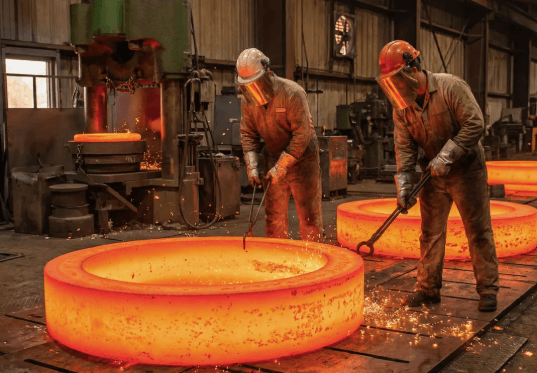
Forging process selection directly affects the grain structure, mechanical uniformity, and fatigue resistance of finished tool joints. Closed-die forging, in which heated steel is shaped under controlled compression within matched dies, produces a continuous grain flow that follows the contour of the part. This characteristic is particularly important for tool joints because the threaded connections and shoulder geometry are load-bearing zones that depend on material integrity rather than surface treatment alone.
Engineers reviewing a potential forging supplier us oil gas tool joint manufacturers typically begin by examining whether the supplier has documented, repeatable experience with closed-die forging at the tonnage and dimensional tolerances required for drill string components. A supplier with general forging capability is not automatically qualified for downhole work. The distinction lies in whether their process controls, tooling management, and die maintenance practices align with what drilling component manufacturing actually demands.
Why Process History Matters More Than Equipment Lists
A supplier might operate presses of sufficient capacity, but process history reveals something equipment lists cannot — whether they have resolved the specific challenges that arise when forging alloy steels for rotary drilling applications. Dimensional consistency across production runs, heat treatment integration, and material traceability are process disciplines that develop over time. Engineers look for evidence of this history in the form of previous approvals, production records, and customer references from comparable applications.
2. Material Traceability from Mill Certificate to Finished Part
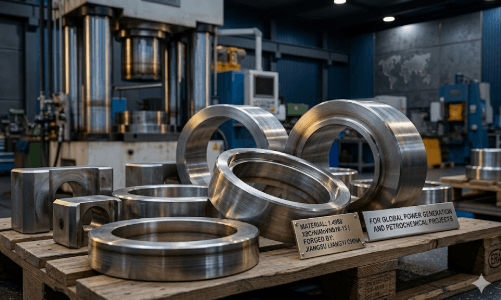
Tool joints are manufactured from specific alloy steel grades selected for their strength-to-toughness balance under cyclic loading. The material specification is not incidental — it is foundational to how the finished component will behave under the thermal, mechanical, and chemical conditions encountered during drilling. Any gap in material traceability represents a quality risk that cannot be fully offset by inspection after the fact.
Qualified suppliers maintain an unbroken chain of documentation from the steel mill certificate through to the finished forging. This includes heat numbers, chemical composition records, mechanical test results, and heat treatment logs. When a tool joint enters service and a question arises about its material properties — whether during a quality audit or following a field incident — that documentation is the only reliable means of answering the question with certainty.
The Risk of Incomplete Records in Vendor Qualification
Suppliers who rely on batch testing or periodic sampling rather than heat-level traceability introduce ambiguity into their quality records. For low-criticality commercial parts, this may be an acceptable trade-off. For drill string components operating thousands of feet below surface under combined loading, ambiguous material records are a disqualifying condition in most serious qualification reviews. Engineers treat traceability as a baseline requirement, not a differentiating feature.
3. Heat Treatment Capability and Process Control
The mechanical properties of a forged tool joint — yield strength, tensile strength, impact toughness, and hardness uniformity — are primarily determined by heat treatment rather than the forging operation alone. Quench and temper cycles must be performed within controlled parameters, using equipment that can demonstrate temperature uniformity across the load and repeatability from batch to batch.
A supplier who subcontracts heat treatment introduces a coordination and accountability gap that complicates quality management. Engineers generally prefer suppliers who perform heat treatment in-house with calibrated furnaces, documented thermal profiles, and verification testing on each heat treat lot. Where subcontracting is unavoidable, the primary supplier must retain clear accountability for the final mechanical results and maintain documented oversight of the subcontractor’s process.
Connecting Heat Treatment Records to Field Performance
When drill string components show premature fatigue cracking or unexpected hardness variation during inspection, heat treatment records are among the first items reviewed during root cause analysis. Suppliers who maintain thorough records — including load positioning charts, temperature logs, and quench media condition records — provide the information needed to determine whether a process deviation occurred. Suppliers without this documentation leave engineers without a reliable starting point for investigation.
4. Compliance with Industry Standards and Third-Party Certification
The oil and gas industry has established well-defined standards for drill string components, including tool joints, through bodies such as the American Petroleum Institute. API standards define requirements for dimensions, material properties, thread form tolerances, and inspection criteria that form the technical baseline for tool joint procurement. Suppliers who hold current API certification for relevant product categories have demonstrated, through third-party audit, that their quality system and manufacturing processes meet these requirements.
Certification alone does not guarantee performance, but it does provide an objective, independently verified confirmation of baseline capability. Suppliers who are not certified and cannot demonstrate an equivalent quality management framework typically face a higher documentation burden during qualification — and in many cases, do not advance beyond preliminary review.
How Certification Scope Affects Qualification Decisions
Not all certifications are equivalent in scope. A supplier certified for one product category is not automatically qualified for another, even within the same facility. Engineers review the specific scope of a supplier’s certification to confirm it covers the product type, material grade, and manufacturing process relevant to tool joint production. Mismatches between certification scope and actual manufacturing activity are a common finding during formal qualification audits.
5. Dimensional Inspection Capability and Statistical Process Control
Tool joint geometry is precise work. Thread form, taper, shoulder dimensions, and bore concentricity must fall within tolerance ranges that allow consistent make-up torque, reliable seal performance, and predictable load distribution in the connection. Suppliers must be able to verify these dimensions using calibrated gauging equipment, and they must demonstrate that their process produces consistent results rather than relying on 100% inspection to catch variation after it occurs.
Statistical process control is the standard by which serious forging suppliers monitor their dimensional output during production. Rather than waiting for end-of-run inspection to reveal a drift in a critical dimension, SPC allows operators to identify and correct process variation before it produces out-of-tolerance parts. Engineers reviewing a potential forging supplier us oil gas tool joint manufacturers look for evidence that dimensional monitoring is built into production, not applied after the fact as a sorting exercise.
Gauge Calibration and Lab Accreditation as Supporting Evidence
Dimensional inspection results are only as reliable as the gauging used to generate them. Suppliers with calibrated gauge management systems — including documented calibration intervals, traceability to national standards, and records of gauge status at the time parts were inspected — provide a more defensible quality record than those who calibrate on an ad hoc basis. Lab accreditation, where applicable, provides additional confidence that test results reflect actual material performance.
See also: Maximizing Business Success Through Digital Marketing
6. Capacity Management and Supply Continuity Planning
A supplier’s technical capability is only part of the qualification picture. Equally important is their ability to deliver consistently against scheduled requirements without introducing lead time volatility or quality degradation when volume increases. Engineers involved in supply chain qualification examine whether a supplier’s stated capacity aligns with their demonstrated output, how they manage material procurement, and what contingency arrangements exist for tooling failures or equipment downtime.
Suppliers who have invested in redundant tooling sets for high-volume tool joint geometries, who maintain working relationships with qualified steel mills, and who carry appropriate raw material inventory buffers are generally better positioned to maintain delivery commitments across a production program. These are operational disciplines that take time to develop and are difficult to replicate quickly under pressure.
The Relationship Between Production Volume and Quality Consistency
Some suppliers perform well at low volumes during qualification but show quality degradation as production rates increase. This pattern typically reflects insufficient process controls — procedures that depend on individual attention rather than system-level discipline. Engineers who have observed this pattern in prior supplier relationships apply particular scrutiny to how a candidate supplier manages high-volume runs, including shift handover practices, operator qualification records, and first-article inspection frequency during sustained production.
7. Responsiveness to Non-Conformance and Corrective Action
No manufacturing process is entirely free of non-conformances. What differentiates a qualified supplier from an unqualified one is not the complete absence of quality issues, but rather how those issues are identified, contained, reported, and resolved. Engineers value suppliers who maintain a formal corrective action system, who report non-conformances proactively rather than waiting to be discovered, and who provide root cause analysis with genuine depth rather than superficial explanations.
A supplier’s historical corrective action records offer meaningful insight into their quality culture. Patterns of recurring non-conformances in the same area suggest that root cause analysis has not been effective. Prompt closure of corrective actions with verified effectiveness checks suggests that quality management is functioning as intended rather than being maintained for documentation purposes alone.
Non-Conformance Handling as a Trust Signal in Long-Term Relationships
In sustained supply relationships for forging supplier us oil gas tool joint manufacturers, the handling of non-conformances over time becomes one of the most reliable indicators of supplier reliability. A supplier who has navigated quality events transparently, communicated clearly with their customer, and implemented corrections that held over subsequent production runs has demonstrated something that qualification audits cannot fully assess — the practical integrity of their quality system under real conditions.
Conclusion: Qualification as a Risk Management Process
Qualifying a forging supplier for oil and gas tool joints is ultimately an exercise in managing operational risk. The seven criteria described here — process competency, material traceability, heat treatment control, standards compliance, dimensional inspection, supply continuity, and corrective action responsiveness — are not abstract ideals. They are practical checkpoints that reflect what can go wrong when any one of them is missing or inadequately developed.
Engineers who have worked through field failures, audit findings, or supply disruptions tend to apply these criteria with particular consistency, because they have seen firsthand what inadequate supplier qualification produces in the field. The qualification process is not a formality. It is the primary mechanism by which engineering and procurement teams confirm that the components entering their drill strings will perform as expected under conditions that leave little margin for error.
For organizations building or revising their approved supplier lists, applying these criteria systematically — and revisiting them at regular intervals rather than treating initial approval as permanent — is the most reliable way to maintain supply chain quality over the long term.