
On-Site vs Classroom Ladder Safety Training: Which One Actually Reduces Workplace Accidents?
Ladder-related injuries remain one of the most consistent causes of lost-time incidents across construction, facilities management, warehousing, and industrial maintenance. The equipment itself is rarely the primary cause. In most documented cases, the failure is behavioral — a misstep, a wrong angle, an overreach that a worker knew better than to attempt but did anyway under pressure or habit. This is what makes the training question so operationally significant. It is not simply about whether workers have been trained, but whether the training they received actually changed how they work.
The debate between on-site and classroom ladder safety training has been ongoing in safety management circles for years. Both formats have genuine merit. Both also have practical limitations that rarely get discussed honestly. For site managers, safety coordinators, and operations leads trying to reduce incident rates rather than just satisfy compliance requirements, understanding how each format performs in practice is worth examining carefully.
How Training Format Shapes Behavioral Outcomes
Training format directly influences how information is retained and, more importantly, whether it transfers into consistent behavior on the job. This distinction matters because compliance training and behavior-changing training are not the same thing, even when they cover identical content. The format determines how closely the learning environment mirrors the conditions under which the skill must be performed.
For organizations working with mobile ladders specifically, this gap between knowledge and application becomes particularly visible. Workers who can correctly describe inspection procedures in a classroom setting often revert to shortcuts on a busy job site. A well-structured Mobile Ladder Safety Training guide can form the backbone of either delivery format, but the format itself determines how that content becomes embedded in daily practice.
Research consistently shows that adults retain procedural skills more reliably when the training environment matches the conditions of actual use. The Occupational Safety and Health Administration has long emphasized that effective safety training must account for workplace-specific hazards rather than generic procedural instruction. When training is delivered in the environment where the work actually happens, the cognitive link between instruction and application is shorter, and retention tends to be stronger.
The Role of Context in Skill Retention
Context is not a soft factor in training design — it has a direct effect on how readily a worker recalls correct behavior when faced with real conditions. A worker who learned how to position a mobile ladder on a level warehouse floor will not automatically apply that knowledge correctly when working on an uneven loading dock ramp. The underlying principle is the same, but the cue to retrieve that knowledge is different because the physical environment is different.
On-site training creates contextual anchors. When a worker practices an inspection or setup procedure on the actual equipment, in the actual space where it will be used, the memory of that action is tied to specific environmental details. Those details act as retrieval cues later. Classroom instruction, by contrast, builds declarative knowledge — an understanding of principles — but does not always build procedural fluency in the conditions that matter.
This does not make classroom training ineffective. It means that classroom training alone is typically insufficient for work that involves physical equipment operated in variable environments. The knowledge gained in a classroom needs to be reinforced through practice in real conditions before it reliably reduces error rates.
What Classroom Training Does Well
Classroom-based ladder safety training has clear strengths, and dismissing it entirely based on limitations in physical skill transfer would be a mistake. Its value lies in what it is well-suited to deliver: structured conceptual knowledge, regulatory context, and consistent messaging across large groups of workers at the same time.
When an organization needs to onboard a large number of workers, train across multiple departments simultaneously, or establish a common understanding of safety standards before workers ever touch equipment, classroom training offers logistical efficiency that on-site delivery cannot easily match. It also allows for controlled discussion, documentation of attendance and comprehension, and the delivery of content that requires written materials or visual reference — hazard identification charts, load ratings, equipment specifications, and regulatory requirements.
Consistency of Message Across a Workforce
One underappreciated benefit of structured classroom delivery is consistency. When safety instruction is delivered verbally by supervisors on the job site, it inevitably varies. Different supervisors emphasize different points, use different language, and hold different tolerances for shortcuts. Over time, these inconsistencies compound into uneven safety culture across teams or shifts.
Classroom training, when developed properly, ensures that every worker receives the same core information in the same format. This matters for organizations managing multiple work crews, subcontractors, or high-turnover environments. It creates a shared baseline that can then be reinforced through practical application. The limitation is that shared baseline knowledge does not automatically translate into consistent field behavior, particularly for physical tasks that require judgment under variable conditions.
Documentation and Compliance Requirements
Classroom settings also make documentation easier to manage. Sign-in sheets, comprehension assessments, and trainer certifications are straightforward to collect and store. For organizations operating under regulatory oversight, demonstrating that workers received structured instruction is a real compliance need, and classroom formats support that record-keeping more cleanly than informal on-site coaching.
That said, documentation of training completion is not evidence of competence. It records attendance, not ability. Safety managers who rely on training records alone as a measure of workforce readiness are measuring the process, not the outcome.
What On-Site Training Does Well
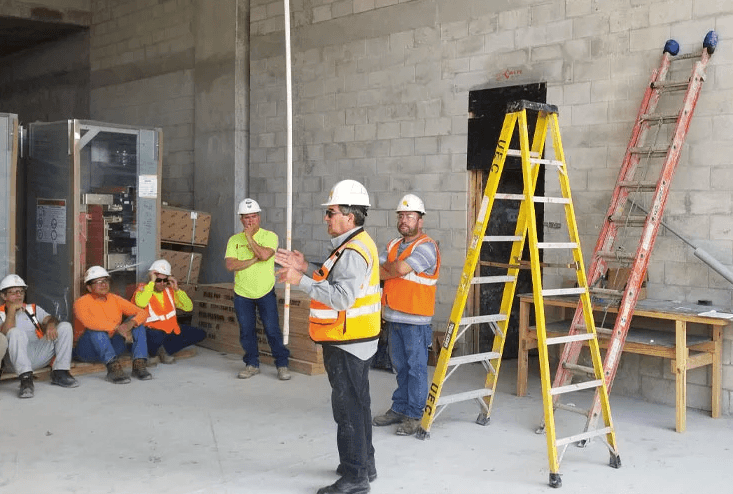
On-site ladder safety training places the worker directly in the environment where errors actually occur. This is its defining advantage. Rather than describing what a stable setup looks like on a flat surface in a training room, on-site instruction demonstrates what stability looks like — and what instability feels like — on the actual floors, surfaces, and configurations the worker encounters during their shift.
Mobile ladder safety training delivered on-site can address site-specific hazards that no standardized classroom curriculum anticipates. Narrow aisles, floor drains, uneven tile, proximity to racking systems, and overhead obstructions are all real variables that affect how a mobile ladder should be positioned and used. A trainer working in that space can identify and address those variables directly, which is something no classroom presentation can fully replicate.
Immediate Feedback on Physical Technique
One of the most consequential differences between on-site and classroom instruction is the availability of immediate corrective feedback during physical practice. When a worker sets up a mobile ladder incorrectly in a warehouse training session, a qualified trainer can intervene immediately, explain what went wrong, and have the worker repeat the setup correctly. That corrective loop — error, correction, repetition — is how physical habits are built and overwritten.
Classroom instruction cannot provide this feedback because there is no physical task being performed. Workers can understand the correct procedure conceptually without ever developing the physical intuition to execute it reliably under pressure. On-site training closes this gap directly, though it requires more planning, more trainer time, and more logistical coordination than a classroom session.
See also: Optimizing Workforce Management for Modern Businesses
Training in Real Work Conditions
Real work conditions involve distraction, time pressure, and the informal norms of a work crew. These factors affect how workers behave around equipment, and they are entirely absent from a classroom setting. On-site training that takes place during or adjacent to actual operations gives workers — and trainers — a more honest view of where behavioral risk actually lives.
This is particularly relevant for mobile ladder safety training in busy operational environments such as distribution centers or maintenance facilities, where the pressure to move quickly is constant and the window for safe setup is often compressed by other demands. Training that ignores this reality produces workers who know the correct procedure but struggle to apply it when the conditions get complicated.
Combining Both Formats for Practical Results
The most defensible approach, given what is known about adult learning and behavioral change, is not to choose one format over the other but to treat them as sequential rather than competing. Classroom instruction establishes the knowledge foundation — terminology, regulatory requirements, hazard categories, and inspection criteria. On-site training then converts that knowledge into practiced behavior by placing workers in real conditions with real equipment and qualified feedback.
This blended model is not new, and it does not require significant additional investment beyond organizing delivery deliberately. The key is ensuring that on-site sessions follow classroom instruction closely enough in time that conceptual knowledge is still fresh and can be connected to physical practice. Long gaps between the two phases reduce the reinforcing effect.
Organizations running mobile ladder safety training programs across multiple sites benefit from standardizing the classroom component while customizing the on-site component to reflect site-specific conditions. This maintains message consistency while ensuring that physical training remains grounded in the actual hazards workers face.
Measuring Whether Training Actually Worked
The ultimate measure of any safety training program is not the training itself but what happens afterward. Incident rates, near-miss reporting frequency, and behavioral observation data are more informative than training completion records. Organizations that track these metrics before and after training interventions are better positioned to assess which format, which trainer, or which curriculum actually moved the needle.
Behavioral observation checklists — supervisors periodically noting whether workers are following correct setup procedures during normal operations — provide direct evidence of training transfer. These do not need to be formal audits. Informal, consistent observation over several weeks following a training session reveals more about real behavioral change than any post-training quiz.
If observed behavior does not change after training, the training design needs to be revisited. That is a practical, operational conclusion, not a criticism of any individual trainer or curriculum.
Conclusion
Neither on-site nor classroom training wins this comparison outright, because the question itself assumes they are alternatives when they function better as complements. Classroom training builds the conceptual foundation that workers need to understand why procedures exist and what regulations require. On-site training builds the procedural fluency and contextual habit that actually reduces the probability of error when conditions are difficult.
For organizations serious about reducing ladder-related incidents rather than simply demonstrating compliance, the format question matters less than the commitment to follow-through. Training that is delivered once, never reinforced, and never evaluated against behavioral outcomes will underperform regardless of format. Training that is structured deliberately, reinforced through observation, and adjusted based on real incident data will reduce accidents — whether it starts in a classroom or on the floor.
The goal is not a trained workforce on paper. The goal is a workforce that consistently makes the right decision in the moment when it matters.