What Maintenance by the Yard’ Actually Means — And Why Most Lawn Care Companies Get It Wrong
When property managers, facilities coordinators, or homeowners begin comparing lawn care services, they often encounter a range of pricing structures that seem interchangeable on the surface. Flat rates, seasonal contracts, per-visit billing — the terminology varies, but the expectations behind each arrangement rarely get discussed clearly. One term that appears frequently but gets used inconsistently is “maintenance by the yard.” It sounds self-explanatory. In practice, it rarely is.
The confusion matters because misaligned expectations between a client and a lawn care provider tend to show up at the worst possible times — mid-season, when overgrowth has gotten ahead of schedule, or at the end of a billing cycle, when the invoice reflects work that doesn’t match what was actually requested. For anyone responsible for managing outdoor spaces consistently, understanding what this service model actually includes — and what it excludes — is a practical necessity, not a fine-print concern.
What the Term Actually Describes
At its core, maintenance by the yard refers to a recurring service arrangement in which upkeep is applied to the entire outdoor yard space — not a single task, not a one-time visit, but ongoing attention to the full condition of a property’s exterior grounds. The emphasis is on continuity. A provider operating under this model takes responsibility for keeping the overall yard in functional condition across multiple visits over a defined period.
This is different from task-based billing, where a client pays per mow or per trimming session. It is also different from a full-service landscape contract, which typically extends into installation, seasonal planting, irrigation, and hardscape work. Yard maintenance in this context sits in a specific middle ground: broad in scope across the property, but focused on preservation and upkeep rather than transformation or construction.
Why the Word “Yard” Carries More Weight Than It Appears
The word “yard” is often used loosely in the lawn care industry to mean whatever the client thinks it means. But in a properly structured maintenance agreement, “yard” should define the physical boundary of the work — the entire usable outdoor area attached to a property, including front, back, and side spaces. It is not a synonym for “lawn,” which typically refers only to grass-covered turf areas.
When a company sells yard maintenance but only manages the turf, a client may reasonably expect that edging along walkways, clearing debris near fences, or managing groundcover near planting beds is included. If the provider has defined “yard” narrowly, those expectations go unmet. The problem is not that one interpretation is wrong — it is that the term was never defined at the point of agreement, and no one corrected the assumption before work began.
Where Most Lawn Care Companies Misrepresent the Model
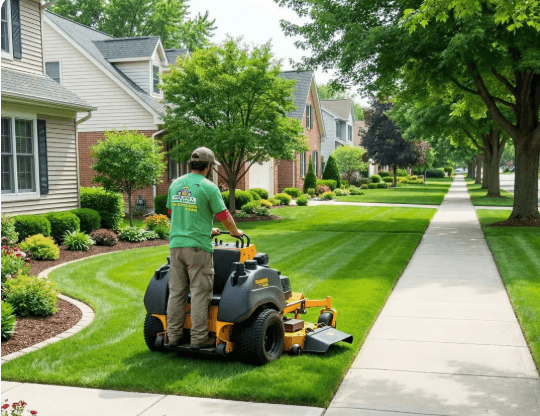
The most common failure in how this service model gets sold is the reduction of yard maintenance to a mowing schedule. Many companies describe their recurring service as yard maintenance because it involves regular visits, but the actual scope never extends beyond cutting grass and perhaps blowing clippings off hard surfaces. That is lawn mowing on a schedule — it is not maintenance by the yard in any meaningful operational sense.
True yard maintenance involves a broader set of activities that keep the entire outdoor environment in stable condition. It includes edge definition along borders, management of overgrowth between visits, debris removal across the full property, and attention to areas that are not turf but are still part of the yard — gravel borders, mulched beds, fence lines, and access paths. When companies omit these elements and still use the term, they are selling a narrower service under a broader label.
The Scope Creep Problem in Recurring Agreements
Recurring service agreements in lawn care are prone to a quiet erosion of scope. A client signs on expecting full-yard attention. Over the first few months, service is thorough. By mid-season, visits feel shorter. By the end of the year, the crew is arriving, cutting the grass, and leaving. Everything outside the turf has been quietly deprioritized. No one made an explicit decision to reduce the service — it simply contracted around the path of least resistance.
This is one of the more difficult issues for clients to identify and address, because there is rarely a clear moment when the change happened. The solution is not vigilance after the fact — it is specificity at the point of agreement. A service description that defines which areas of the yard are included, at what frequency, and under what conditions gives both parties a shared reference point when performance questions arise.
How Pricing Structures Distort the Definition
Some companies price yard maintenance by the square footage of the lot. Others price by visit duration or by a flat monthly rate. None of these pricing models, on their own, ensure that the full yard is being maintained — they only establish what the client is paying. When a flat-rate model is used without a clear scope of work, the provider has a financial incentive to keep visits brief and coverage narrow. The client is paying for yard maintenance; the provider is delivering the minimum required to satisfy the contract as they understand it.
This misalignment is not always intentional. It often reflects the fact that neither party took the time to define scope precisely before the agreement started. But the practical outcome is the same regardless of intent: the client ends up with a yard that receives partial attention at a price that was quoted for full coverage.
What a Properly Structured Yard Maintenance Agreement Looks Like
A well-constructed maintenance agreement for a residential or commercial yard should identify the scope of the property, specify which zones are included in routine service, and define the frequency of visits for different types of work. Not every task needs to happen at every visit — but every area of the yard should be accounted for somewhere in the agreement.
Routine visit expectations should be written out clearly, including what gets done to grass areas, what gets done to non-turf areas, and how seasonal changes affect the scope. If debris removal, edging, and bed maintenance happen on different cycles, that should be stated rather than assumed. The goal is not to produce a legal document — it is to produce a shared understanding that both parties can return to when questions arise.
See also: Best Flush Door Designs for Minimalist Homes
The Role of Consistency in Measuring Service Quality
One of the clearest ways to assess whether a yard maintenance provider is delivering on the model they sold is consistency across visits. A provider performing genuine yard maintenance should leave the property in comparable condition after each visit, regardless of whether it rained the week before, whether growth was heavier in one area, or whether the crew was different than the previous time. Variability in outcomes across visits is one of the stronger indicators that the service is being delivered reactively rather than systematically.
Consistency is not the same as rigidity. A good provider adjusts to seasonal conditions and growth patterns. But the overall standard — the condition in which the yard is left — should remain stable. According to the U.S. Environmental Protection Agency’s guidelines on grounds management, maintaining consistent turf and landscape health requires attention to soil conditions, plant stress, and environmental factors across the full outdoor space — not just the visible grass surface. That broader view is exactly what distinguishes real yard maintenance from routine mowing.
Questions Worth Asking Before Signing a Maintenance Agreement
Before committing to any recurring yard maintenance service, a few specific questions can reveal how a provider actually defines their service:
• Does the agreement cover the full yard — including side yards, fence lines, and non-turf areas — or only the primary lawn surface?
• What happens to debris, overgrowth, and accumulation between visits in areas that are not regularly mowed?
• If conditions require additional attention — after a storm, during a fast-growth period — is that addressed within the existing agreement or billed separately?
• How are scope changes communicated, and what is the process if something is missed during a visit?
• Is the same crew assigned to the property across visits, or does staffing change week to week?
These questions are not designed to challenge the provider — they are designed to establish clarity. A provider who can answer them specifically and confidently is operating with a defined service model. One who responds vaguely or redirects to pricing is likely operating informally, which increases the probability of inconsistency over time.
Closing Thoughts
The phrase “maintenance by the yard” represents a legitimate and practical service model when it is applied honestly. It describes ongoing, whole-property upkeep delivered at regular intervals — a model that benefits any property owner who wants a consistent outdoor environment without managing individual tasks piecemeal. The problem is not the model itself. The problem is that the term has been adopted broadly without consistent meaning behind it.
For anyone managing outdoor property — whether a single residence, a rental unit, or a commercial facility — the most useful thing to understand is that yard maintenance is not a default category. It is a defined scope of work, and that definition should be established explicitly before service begins. When it is, the model works well. When it is not, the gaps tend to accumulate quietly until they become visible problems.
Selecting a provider is less about finding the lowest price and more about finding one whose definition of the service matches what you actually need. That starts with asking the right questions and insisting on specific answers — not before assuming that a familiar phrase means the same thing to everyone who uses it.