
Is Chainsaw Man violent? What readers should really expect
Some manga flirt with danger. Chainsaw Man walks straight into it with blood on its shoes, noise in its pages, a pace that rarely lets the reader breathe. That reputation often leads to a simple question: is Chainsaw Man violent? The honest answer is yes, though that single word does not say enough. The manga contains gore, dismemberment, brutal fights, sudden deaths, monstrous imagery, psychological pressure, sexual tension, fear, grief, moral instability. Still, it would be inaccurate to reduce the series to a pile of shocking panels. Its violence has a shape, a rhythm, a purpose inside the story. It helps define the world, the devils, the social order, the emotional emptiness of some characters, the hunger driving others, and the unstable line between comedy and horror. Readers who want a precise answer usually are not asking only whether blood appears on the page. They want to know whether the series is unbearable, whether it feels childish or mature, whether the brutality is constant, whether a teenager can handle it, whether the manga is darker than the anime, whether the violence is meaningful or excessive. Those are the real questions, the ones that matter before buying a volume, recommending it, or handing it to a younger reader. This article tackles that search intent directly. No fog, no overstatement. You will see what kind of violence appears in Chainsaw Man, how graphic it becomes, why the tone can feel more disturbing than the blood itself, and what type of audience is most likely to enjoy it without feeling blindsided.
Why Chainsaw Man feels so violent from the first chapters?
The reason Chainsaw Man manga violence feels intense so quickly is not only the amount of blood. The manga introduces a world where bodies are fragile, devils are everywhere, and survival often depends on entering a contract that costs something real. That setup gives every fight a hard edge. When people search for whether the series is violent, they often picture action scenes full of gore, and that is part of it. Limbs are cut, faces are damaged, human bodies are torn apart, devils are sliced into grotesque shapes. The visual language is aggressive by design. Even so, what really amplifies the impact is how little comfort the story offers around those moments. There is rarely a soft landing after something terrible happens. A scene can turn from absurd comedy to carnage in a few pages, which keeps the reader uneasy. That abrupt swing is one of the manga’s signatures. It behaves like a live wire dropped into a puddle: energy spreads fast, unpredictably, with no safe place to stand.
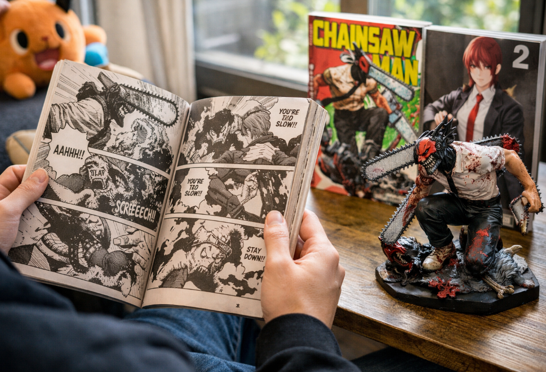
That same intensity helps explain why fans often collect visual material tied to the series’ strongest scenes and characters, whether out of admiration for the art style or fascination with its chaotic atmosphere. For readers browsing merchandise after discovering the series, Chainsaw Man figures often reflect that exact identity: sharp designs, feral poses, unsettling power, a look that captures the manga’s violent energy without needing to reproduce every graphic detail. In other words, the violent reputation of the manga is not accidental branding. It is built into the characters, the devil concept, the page composition, the abrupt pacing, the constant risk of bodily destruction. That is why even people who have only seen covers or clips already sense that this is not a calm shonen adventure. The manga wants the reader to feel pressure. Its violence is part of that pressure from the opening stretch.
Another point matters here: the series does not frame violence as noble or glamorous in a classic heroic sense. Denji is not a polished warrior chasing honor. He is crude, needy, impulsive, hungry for basic human comfort. That changes how violent moments land. They feel messy, desperate, sometimes pathetic, sometimes hilarious in a deeply strange way. A reader exploring the broader universe through an anime figures store may notice that even the collectible side of the franchise emphasizes this rough contrast between cool style and raw instability. That reflects the manga well. The story is flashy, though never clean. It is entertaining, though rarely safe. It can be funny inside a scene that should be horrifying. For many readers, that tonal instability makes Chainsaw Man feel more violent than another manga with a similar body count, because the experience becomes emotionally jagged rather than visually repetitive. The page does not merely show damage. It unsettles the reader’s footing.
What kind of violence appears in the manga?
Anyone asking whether Chainsaw Man is gory should know that the violence is both physical and atmospheric. The physical side is easy to identify. The manga includes heavy bloodshed, decapitation, impalement, torn flesh, weaponized bodies, mutilation, monsters feeding on humans, and exaggerated combat damage. Devils are not neat enemies. They often look wrong in a deliberate, uncanny way, which makes their attacks feel even harsher. Human characters also suffer visibly. Pain has texture in this series. Injuries do not always vanish under clean action choreography. Fujimoto often draws impact in a way that feels dirty, abrupt, and chaotic. That visual disorder adds force to scenes that might otherwise feel routine in action manga.
The second type of violence is psychological. This part is just as important, sometimes more important. The manga contains emotional manipulation, sudden loss, unstable authority figures, traumatic backstories, exploitation, dehumanization, and recurring reminders that affection can be transactional or dangerous. Some readers can handle gore without much trouble yet still find Chainsaw Man disturbing because its emotional world is cold. Characters are frequently used by systems stronger than them. Bonds can be sincere, though trust remains fragile. Hope exists, though it is often surrounded by dread. A panel of blood may shock for a second; the realization that a character has been psychologically cornered can linger much longer. That is one reason the manga’s violence does not feel superficial. The damage is not limited to flesh.
Its violent content usually falls into a few recurring categories:
- Blood
- Gore
- Dismemberment
- Monsters
- Death
- Trauma
- Fear
- Manipulation
- Sexual tension
- Cruelty
That list helps, though context matters more than labels. Many action manga contain blood and death. Chainsaw Man stands out because of the frequency of danger, the visual ferocity of devil encounters, the bleak humor wrapped around tragedy, and the feeling that almost no one is fully safe. Readers sensitive to gore should take the warning seriously. Readers more concerned about emotional darkness should also pay attention, because the series is not merely violent in a visual sense. It can feel nihilistic, intimate, and disturbing in ways that bypass the obvious red flags.
Is Chainsaw Man more disturbing than simply bloody?
Yes, often. That distinction matters because some violent series are easy to categorize: they are graphic, brutal, straightforward. Chainsaw Man is harder to pin down because it can be juvenile on the surface, philosophical underneath, ridiculous in one panel, emotionally bruising in the next. That instability changes the reading experience. A person expecting only gore may be surprised by how empty, lonely, or warped the characters can feel. The series frequently explores desire in raw forms: hunger, lust, affection, belonging, comfort, power, identity. Those desires are rarely presented as clean or fully healthy. Violence grows around them like weeds through cracked concrete. This creates a more troubling atmosphere than blood alone ever could.
Some of the most memorable scenes are disturbing not because they show the most extreme body horror, though because they reveal how vulnerable people become when they crave love, approval, or normal life. Denji’s simplicity is part of the manga’s brilliance. He wants things that sound small, almost embarrassingly basic. Food. Touch. Rest. A better life. That makes the surrounding cruelty sharper. The reader sees how easily those desires can be exploited. The manga turns ordinary emotional hunger into a pressure point, and that pressure point is repeatedly hit. In that sense, the violence of Chainsaw Man is not just spectacle. It is also a method of exposing weakness, dependence, and the cost of being emotionally unprotected.
There is also the matter of unpredictability. Many readers feel less disturbed by violent content when they understand the story’s moral structure. In some series, the heroes are clearly protected by the narrative, villains are clearly marked, losses are staged with enough warning to soften the blow. Chainsaw Man often resists that comfort. Sudden reversals and abrupt deaths can make the world feel unstable. When the floor keeps moving, every scene grows heavier. That is why people who ask “is Chainsaw Man violent” are sometimes really asking whether it is emotionally rough. The fairest answer is that the manga can be more upsetting than its splashy marketing suggests. The blood draws the eye. The emotional dislocation is what stays under the skin.
How the manga compares with the anime in violence level?
Readers who discovered the story through animation often wonder whether the manga is harsher than the anime. In broad terms, the core violent content is present in both, though the manga can feel more abrupt and jagged because the reading rhythm is in the hands of the reader. A shocking page turn can land like a door kicked open. The anime adds motion, sound, and atmosphere, which can heighten tension in some scenes, though the manga’s line work and pacing can make violence feel more immediate in another way. Fujimoto’s panels often carry a rough momentum that works especially well for chaos. There is less cushioning. The art can look loose, fast, aggressive, which suits a story built on instability.
Another difference comes from imagination. When a reader sees a static image of gore in a manga, the mind fills the space around it. That can make certain moments feel more personal or more disturbing than a fully animated sequence. The anime is striking, polished, cinematic. The manga can feel closer to the nerve. It is less about which version has “more” violence in a mechanical sense and more about which medium hits your sensitivity harder. People who are uncomfortable with blood and body damage will likely find both versions intense. People who are more affected by implication, timing, and sudden tonal cuts may find the manga rougher because it delivers shocks with less warning and fewer sensory buffers.
See also: Optimizing Workforce Management for Modern Businesses
Why page turns change the impact?
A manga page controls time differently from animation. Your eyes choose the speed. You pause longer on one panel, rush through another, turn a page and meet a full-image shock without any soundtrack preparing you. That structure gives violent revelations a particular force. In Chainsaw Man, that force is used well. The layout can build tension through silence, then smash it with a grotesque image or a brutal reversal. This is one reason some readers say the manga feels more vicious even when the scene itself is familiar from the anime. There is no musical cue telling you to brace. No voice acting guiding emotion. Only composition, contrast, and surprise. The result can be colder, sharper, more invasive. The scene arrives all at once, like stepping onto what looked like solid ground and finding glass instead.
Why animation can make brutality feel smoother?
The anime, by contrast, can make violent material feel more fluid. Motion gives coherence to chaos. Sound design adds mood. Color adds realism, though it can also aestheticize what the manga leaves rougher. That does not mean the anime is soft. It means the viewer is being led through the violence in a more directed way. Some people find that easier to tolerate. Others find moving images harder to stomach. The practical answer for cautious readers is simple: if the anime already felt close to your limit, the manga will probably not feel safer. If the anime felt manageable and you are comfortable with graphic fiction, the manga is unlikely to be a problem, though it may still surprise you with how severe certain turns feel on the page.
Who should read it and who may want to wait?
Chainsaw Man is best suited to readers who can handle graphic action, dark humor, emotional volatility, and morally messy characters. It fits people who enjoy horror-inflected manga, stories with sharp tonal contrast, and narratives that are willing to make major events feel sudden rather than ceremonious. It may not suit readers looking for a comforting shonen rhythm, a stable heroic arc, or violence presented in a clean, consequence-free way. It also may not suit younger readers simply because the content is not limited to action brutality. The manga includes disturbing themes and sexual undertones that make the overall maturity level higher than its loud premise may suggest.
A useful rule is to think less in terms of age alone and more in terms of sensitivity. Some older teens can read the series without issue because they are already familiar with darker manga and understand how fiction can mix horror, satire, grief, and absurdity. Some adults may dislike it because the violence feels too jagged or emotionally sour. Taste matters. Tolerance matters. Context matters. If a reader is bothered by dismemberment, large amounts of blood, unsettling monster design, abrupt death, manipulative relationships, or emotional cruelty, then caution is reasonable. If a reader enjoys works that challenge comfort and do not soften the uglier sides of human desire, then Chainsaw Man has a great deal to offer.
That is the most accurate recommendation possible: do not judge the manga by gore alone. Judge it by its full texture. It is loud, funny, ugly, tense, inventive, tender in strange places, cruel in others. Its violence is part of a larger system of pressure that defines the reading experience. Someone asking whether it is “too violent” is really asking whether the whole package crosses a personal threshold. For many readers, it does not cross that line because the story’s energy, character writing, symbolism, and momentum justify the harshness. For others, the mixture of gore and emotional discomfort is exactly what makes it too much. Both reactions are fair.
Why the violence serves the story instead of existing for shock alone?
One reason Chainsaw Man has stayed so widely discussed is that its brutality is tied to theme. Devils are not random monsters. They emerge from fear. That concept alone gives violence symbolic weight. The world is shaped by what people dread, which means every violent confrontation says something about human anxiety as well as survival. The manga also uses bodily transformation and destruction to explore identity. Denji’s body is not stable in a traditional human sense. His relationship to pain, labor, and consumption becomes part of the story’s language. Violence, then, is not decoration. It is woven into the series’ ideas about fear, poverty, exploitation, appetite, and control.
This does not make every bloody panel profound. Some scenes are meant to be thrilling, grotesque, funny, or purely chaotic. Still, the overall design of the series prevents the violence from feeling empty. Major scenes often reshape relationships, expose character motives, shift power, or reframe earlier assumptions. When readers call the manga violent, they are correct. When they imply that it is only violent, they miss what gives that violence staying power. A random splatter does not usually stick in memory. A splatter attached to grief, manipulation, longing, or revelation often does. Chainsaw Man understands that difference.
That is also why the manga attracts people who normally do not chase gore-heavy fiction. Beneath the blood is a story about need. Need for affection. Need for dignity. Need for ordinary happiness. Need for agency. Those needs are easy to recognize, which keeps the manga human even when it becomes monstrous. The chainsaw is the loudest image, though the engine underneath is emotional deprivation. Once that becomes clear, the violence feels less like random noise and more like a brutal grammar the story keeps using to express what its characters cannot say cleanly.
What to keep in mind before starting the series?
If you are still deciding whether to read it, the clearest answer is this: Chainsaw Man is violent, graphically so in many scenes, though its reputation comes equally from its disturbing tone, emotional harshness, and unpredictable storytelling. Expect blood, gore, monster horror, brutal combat, and dark comedy. Expect unstable relationships, ugly power dynamics, sudden turns, and a world that rarely feels safe. Do not expect a neat heroic fantasy where violence is sanitized and easily forgotten. This manga bites down harder than that.
For readers comfortable with violent manga, Chainsaw Man is usually not violent in a pointless way. It is harsh, though alive with purpose, style, tension, and unsettling emotion. For readers who are unsure, the best approach is honesty about your own limits. If gore, dread, and emotional cruelty tend to weigh on you, this series may be too sharp. If you can handle a story that mixes chaos with depth, horror with absurd humor, you may find that its violence is not a wall blocking the experience, though the very tool that carves its identity.