
How Google Ads Agencies Use Machine Learning for Keyword Optimization
Remember the good old days of keyword research? You would brainstorm a list, check search volumes, dabble in competitor analysis, and then cross your fingers. It was like trying to catch fish with a single net in a vast, ever-changing ocean. Effective at times, but far from efficient or future-proof.
Fast forward to today, the game has changed completely. We are no longer guessing; we are using sonar, drones, and AI-powered nets to find exactly the right catch. At the center of this evolution is machine learning. For a modern Google Ads Agency, machine learning is not a buzzword. It is the engine driving smarter, more precise keyword targeting. It helps agencies move beyond educated guesses into predictive analytics, ensuring ad spend works harder and smarter. Machine learning does not replace strategists. It empowers them with insights and automation that transform a complex process into a streamlined, highly effective one.
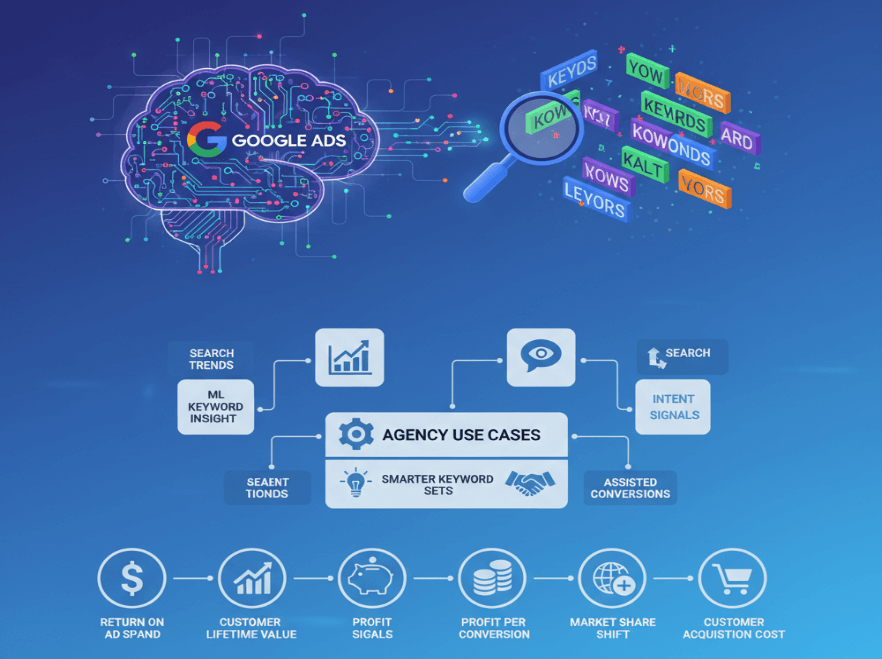
ML Keyword Insights
Machine learning brings depth, accuracy, and speed to keyword analysis that humans alone cannot match. It scans vast datasets, uncovers patterns, and finds opportunities long before competitors notice them.
Search Trends
One of machine learning’s strongest capabilities is identifying and predicting search trends. The digital landscape shifts constantly. New products appear, consumer interests evolve, and seasonal demand fluctuates. Tracking all this manually is nearly impossible.
Machine learning analyzes historical search data, real-time query behavior, and external factors such as news, social buzz, and seasonality. This helps determine not just what is trending, but the trajectory of that trend. It can reveal whether a search spike is temporary or the beginning of a long-term opportunity. This allows agencies to discover emerging long-tail keywords before competitors see them, giving clients a strong first-mover advantage.
Intent Signals
Beyond what people search, machine learning helps decipher why they are searching. A keyword like best running shoes may indicate research, comparison, or purchase intent. Without understanding this context, you might show the wrong ad and waste budget.
Machine learning evaluates search history, time of day, device type, geo-location, and session behavior to identify whether the user intent is informational, navigational, commercial, or transactional. By aligning ads and landing page experiences with intent, agencies improve conversion rates and identify important negative keywords. This prevents wasted spend and ensures that ads reach the right audience at the right moment.
Agency Use Cases
Machine learning is not just theory. For agencies, it changes how keyword strategies are built, optimized, and scaled.
Smarter Keyword Sets
Machine learning allows agencies to create dynamic keyword portfolios instead of static lists. These keyword sets evolve automatically, discovering new variations, identifying irrelevant terms, and reallocating budget to top performers. Machine learning learns continuously from performance data. If a keyword or cluster underperforms, it recommends adjustments or pauses it. If new opportunities appear, it surfaces them immediately.
This leads to smarter allocation, stronger intent alignment, higher-quality clicks, and better ROI. This is the foundation of modern Google Ads management. Machine learning also improves bid strategies. By predicting conversion probability for different keyword intents, it helps agencies set optimized bids and maximize impact for every dollar spent. This is why advanced adword management services outperform traditional keyword research and manual optimization.
Key Takeaways
Machine learning revolutionizes keyword optimization by moving beyond traditional methods to predictive analytics. ML identifies emerging search trends and long-tail opportunities, giving agencies a proactive edge. It deciphers user intent (informational, transactional, navigational) to match ads with precision, improving conversion rates and identifying negative keywords. Agencies use ML to create dynamic, self-optimizing keyword sets that continuously adapt for maximum ROI. This advanced approach ensures smarter ad spend, more valuable clicks, and superior overall campaign performance.
Conclusion
The landscape of Google Ads Agency is constantly evolving, and staying ahead requires more than just intuition; it demands intelligent, data-driven strategies. Machine learning isn’t just a tool; it’s a fundamental shift in how we approach keyword optimization, enabling agencies to unlock unprecedented levels of precision and efficiency for their clients. By embracing ML, agencies are not only navigating the complexities of the digital advertising world but actively shaping its future, delivering smarter, more impactful campaigns that truly drive business growth.