Forged Rings Manufacturing in the US: A Complete Buyer’s Guide for Engineers and Procurement Teams
When a component fails mid-operation in a refinery, a wind turbine, or a commercial aircraft, the consequences are rarely limited to the part itself. They extend outward into downtime, liability, inspection cycles, and in some cases, safety events that take weeks to fully resolve. For the engineers and procurement professionals responsible for specifying critical components, the material and manufacturing process behind each part carries real weight — not as an abstraction, but as a daily operational concern.
Forged rings sit at the center of this responsibility. They appear in rotating equipment, pressure-bearing assemblies, flanged connections, and structural joints across nearly every heavy industry. Understanding how they are manufactured, what distinguishes quality in this category, and how to evaluate domestic suppliers is not a purchasing exercise — it is a risk management function. This guide is written for those doing the actual work of sourcing, specifying, and qualifying forged ring components in the United States.
What Forged Rings Are and Why Manufacturing Method Determines Performance
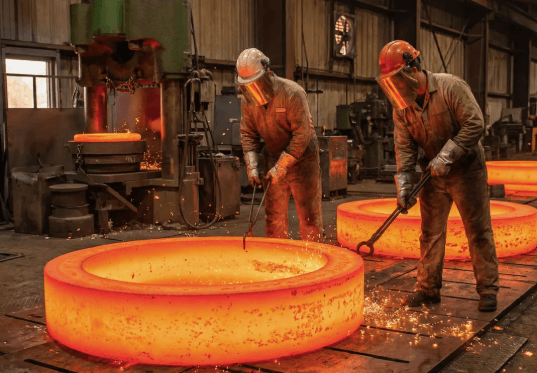
A forged ring is a seamless, annular metal component produced by applying compressive force to a heated billet of metal until it takes the shape of a ring. The process typically involves punching a hole through a heated metal disc and then rolling or pressing the resulting form outward to achieve the desired diameter and cross-section. This method produces a component where the grain structure of the metal flows continuously around the circumference, following the shape of the part rather than being cut across it.
This is the critical mechanical distinction. When a ring is machined from bar stock or plate, the grain flow runs in a linear direction through the material. The ring shape intersects that grain at multiple points, creating pathways where stress can propagate more easily. A ring produced by a qualified forged rings manufacturer avoids this entirely, because the forging process aligns the grain structure with the geometry of the finished part. The result is a component with greater resistance to fatigue, better impact toughness, and more consistent mechanical properties under cyclic loading.
For procurement teams, this distinction matters when specifying components for applications where failure would require an unplanned shutdown or pose a safety risk. Knowing why forging produces a better component allows engineers to write more precise specifications and push back intelligently when substitutions are proposed.
Rolling vs. Open-Die Forging for Ring Geometries
Two primary methods are used to produce forged rings at commercial scale: ring rolling and open-die forging. Ring rolling is a continuous process in which a heated donut-shaped preform is placed between a driven roll and an idler roll. As the rolls apply pressure, the ring expands in diameter while its wall thickness and height are controlled by additional tooling. This process is efficient for producing rings in large quantities and across a wide range of diameters.
Open-die forging, by contrast, involves working a heated billet between flat or shaped dies without enclosing the material in a cavity. For rings, this often means punching and drifting a heated cylinder to create the annular form, then finishing the geometry through press work or additional tooling. Open-die forging offers more flexibility for low-volume, large-diameter, or custom-cross-section parts where ring rolling tooling would be impractical.
Neither method is universally superior. The right choice depends on the application, required tolerances, production volume, and the alloy being worked. Engineers specifying forged rings for critical applications should understand both methods well enough to ask informed questions during supplier qualification.
Material Selection and Its Connection to Application Performance
Forged rings are produced in a broad range of metals, including carbon steel, alloy steel, stainless steel, aluminum alloys, titanium, and nickel-based superalloys. Each material family carries different mechanical properties, thermal behavior, corrosion characteristics, and cost profiles. The material selected for a forged ring must match the mechanical demands of the application and the environmental conditions the component will face over its service life.
Carbon and low-alloy steels are the most common materials for general industrial applications, including flanges, gear blanks, bearing races, and structural rings. They are relatively cost-effective to forge, widely available in domestic supply chains, and well-characterized in terms of mechanical behavior. Stainless steels are used where corrosion resistance is required alongside mechanical strength, particularly in chemical processing, food production, and marine applications.
How Heat Treatment Affects Mechanical Properties After Forging
Forging alone does not fully determine the mechanical properties of the finished ring. Heat treatment applied after forging plays an equally important role. Processes such as normalizing, annealing, quenching, and tempering control the microstructure of the metal and determine its final hardness, tensile strength, yield strength, and ductility. For procurement teams, this means that a specification sheet for a forged ring should account for both the forging process and the post-forge heat treatment condition.
A ring that is forged correctly but heat-treated improperly can still fail to meet application requirements. Conversely, a supplier who manages both the forging process and the subsequent thermal processing under a unified quality system reduces the risk of property inconsistencies that arise when these operations are split between facilities. When evaluating domestic suppliers, it is worth asking whether heat treatment is performed in-house or subcontracted, and how process parameters are documented and verified.
See also: Maximizing Business Success Through Digital Marketing
Alloy Considerations for High-Temperature and High-Stress Environments
Applications in power generation, aerospace, and oil and gas frequently demand materials that maintain mechanical properties at elevated temperatures or under severe cyclic stress. Nickel-based alloys and certain grades of titanium are used in these contexts specifically because of their ability to resist creep, oxidation, and thermal fatigue. These materials are significantly more difficult to forge than carbon steels, requiring tighter process controls, specialized tooling, and more careful thermal management throughout the forging cycle.
Procurement teams sourcing forged rings in these materials should confirm that a prospective supplier has demonstrated experience with the specific alloy in question, not just general forging capability. The difference in process complexity between forging mild steel and forging a nickel superalloy is substantial, and that experience gap shows up in dimensional consistency, surface condition, and mechanical test results.
Quality Assurance Practices That Distinguish Reliable Suppliers
In the forged rings category, quality assurance is not a downstream verification step — it is embedded throughout the manufacturing process. Suppliers who treat inspection as a final checkpoint rather than an integrated practice tend to produce more variable results, particularly across long production runs or when working with challenging alloys. For engineers and procurement teams, understanding what a robust quality system looks like in this context is essential to supplier qualification.
Material traceability is the foundation. Every forged ring should be traceable to a specific heat of metal, with records linking the raw material to the certified mill test report. This traceability allows for root cause investigation if a field failure occurs and supports compliance with standards set by organizations such as the ASTM International, which publishes widely referenced specifications for forged steel and other metallic materials used in pressure equipment and structural applications.
Non-Destructive Testing Methods and When They Apply
Non-destructive testing is used to detect internal or surface discontinuities in forged rings without compromising the part. Common methods include ultrasonic testing, magnetic particle inspection, liquid penetrant testing, and radiographic examination. Each method has a specific detection capability and range of applicability depending on the material, geometry, and defect type of concern.
Ultrasonic testing is particularly relevant for forged rings because it can detect internal flaws — voids, inclusions, or laminations — that would not be visible on the surface. For rings destined for pressure-containing or rotating applications, specifying ultrasonic testing as part of the acceptance criteria is a reasonable baseline requirement. Magnetic particle and liquid penetrant methods address surface and near-surface discontinuities and are commonly used in addition to volumetric methods on critical parts.
Certifications and Standards That Support Procurement Decisions
Certifications such as ISO 9001 confirm that a supplier operates within a documented quality management system, but they do not verify the quality of any specific product. Industry-specific certifications and compliance with applicable material specifications carry more weight in the context of forged ring procurement. ASTM, ASME, and API standards define requirements for forged components used in specific applications, and a supplier’s demonstrated familiarity with these standards provides a meaningful baseline for evaluation.
Procurement teams should request documentation of recent certifications, review sample material test reports, and ask about the supplier’s internal rejection rates and corrective action processes. These conversations reveal more about operational quality discipline than a certificate on a wall.
Evaluating US-Based Forged Ring Suppliers as a Procurement Decision
Sourcing forged rings from domestic manufacturers carries practical advantages that extend beyond lead time. Communication is simpler, facility audits are logistically feasible, and the supplier operates within the same regulatory and standards environment as the buyer. For applications subject to quality clauses, source inspection requirements, or national content provisions, domestic sourcing often removes complications before they arise.
When evaluating a domestic forged rings manufacturer, the relevant factors include the range of materials and ring sizes the supplier can competently produce, the manufacturing processes they control in-house versus outsource, their experience with the specific industry and application type, and their capacity to support repeat orders with consistent quality. Suppliers who can demonstrate material traceability, maintain controlled process documentation, and offer transparent quality records are better positioned to support critical procurement relationships over the long term.
• Confirm that the supplier has in-house heat treatment capability for the alloys in your specification, reducing the risk of property variation from outsourced thermal processing.
• Request sample material certifications and review them for completeness — a well-organized cert package reflects internal process discipline and traceability habits.
• Ask about the supplier’s familiarity with relevant ASTM or ASME standards for your application, particularly if the rings will be used in pressure equipment or rotating machinery.
• Evaluate lead time commitments in the context of the supplier’s current capacity, not just their quoted standard turnaround — capacity constraints are the most common source of schedule risk.
• Consider whether the supplier supports source inspection or third-party witnessing for first articles, which provides an additional layer of confidence on new part introductions.
Conclusion: Making Informed Decisions About Forged Ring Sourcing
The decisions made during the specification and sourcing of forged rings have consequences that extend well beyond the purchase order. A ring that meets dimensional tolerances but carries internal inconsistencies from poor process control can perform adequately for years — and then fail at exactly the wrong moment. Understanding the manufacturing process, the material behavior, and the quality practices behind a forged ring gives engineers and procurement teams a more grounded basis for making those sourcing decisions.
Domestic US suppliers of forged rings vary considerably in their process capabilities, material breadth, and quality discipline. The strongest relationships in this category are built on transparency — suppliers who can show their work, document their processes, and respond clearly to technical questions. For procurement teams managing critical component supply chains, that transparency is not a courtesy; it is a qualification criterion.
Approaching forged ring procurement with the same rigor applied to other critical components — through clear specifications, meaningful qualification conversations, and documented quality requirements — is the most reliable way to reduce risk and maintain supply chain integrity over time.