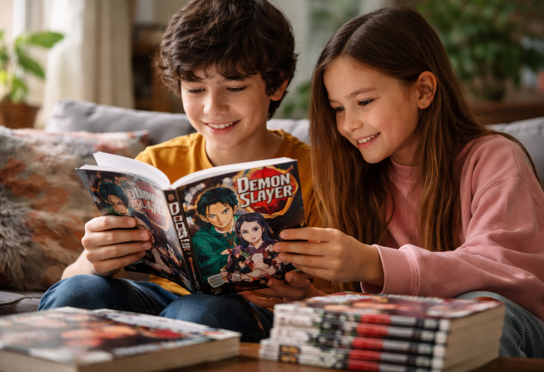
Is Demon Slayer manga suitable for children?
Demon Slayer has become one of the most recognisable manga series of recent years, which explains why many parents, older siblings, teachers, and young readers themselves want a clear answer before opening the first volume. The central question is not whether the series is famous, stylish, or widely discussed at school. The real issue is much more concrete: does the manga contain material that may be too violent, too sad, or too frightening for a child? That is where a careful reading matters. Demon Slayer tells the story of Tanjiro Kamado, a boy whose family is slaughtered by demons, while his sister Nezuko survives in altered form. From that starting point, the series mixes grief, sword fights, moral conflict, loyalty, training, sacrifice, grotesque enemies, and moments of warmth. Its heart is often compassionate, though its pages can also feel like a storm cloud rolling across a bright sky. A child may see bravery and sibling devotion. Another may focus on blood, severed limbs, despair, and disturbing monster designs. That difference matters. Manga is also read differently from television. The reader controls pace, lingers on panels, studies expressions, returns to intense pages, and imagines movement between frames. For some children, that makes the emotional effect stronger. For others, the black-and-white artwork softens the blow compared with animated scenes. A good answer therefore cannot be lazy or vague. Demon Slayer is not a simple children’s comic, even if many younger fans know the title. It sits in a space where content, maturity, age, and parental awareness all count. The most helpful approach is not to ask whether one child somewhere managed to read it without trouble. The better question is whether your child is ready for its themes, imagery, and tone. That is the lens used throughout this article.
Why Demon Slayer attracts younger readers so easily
Demon Slayer appeals to children and young teens for obvious reasons. The character designs are memorable, the emotional bond between Tanjiro and Nezuko is immediate, the fights are dynamic, and the world is easy to understand at first glance: humans versus demons, danger versus courage, family versus cruelty. That clarity gives the series a very strong entry point, even for readers who are still discovering manga. It also helps that the story is tied to a huge cultural wave. A child may hear about the series from classmates, see merchandise in shops, watch short clips online, or browse themed products on anime shops before even reading a single page. That social familiarity can make the manga feel more child-friendly than it really is. Popularity often creates a false sense of softness. A title becomes visible everywhere, which leads adults to assume it belongs naturally alongside lighter youth entertainment. Demon Slayer does have warmth, humour, perseverance, discipline, and touching family loyalty. Those elements are genuine. Still, they exist beside darker content that should not be brushed aside. Young readers are especially drawn to stories where children or teenagers face overwhelming odds and grow stronger. Tanjiro fits that pattern perfectly. He is polite, determined, empathetic, hard-working, and easy to admire. Nezuko, with her unusual condition and protective role, adds mystery without removing affection. Their bond gives the story a powerful emotional centre, which is one reason so many young readers want to follow them. That said, attraction is not the same as suitability. A child may love the concept while struggling with the execution. Many manga that become playground favourites are discussed in fragments: a cool sword, a favourite character, an exciting battle, a costume, a pose, a collectible. The full reading experience is far denser. Demon Slayer often asks readers to absorb suffering, body horror, tragic backstories, ruthless combat, and scenes where innocent people are in real danger. That contrast between accessible surface and harsher content is exactly why parents should look beyond the brand name. A familiar title can still contain material that lands heavily on a younger mind, especially when the child is sensitive, prone to nightmares, or emotionally affected by stories about family loss.
What the manga actually contains on the page
Anyone trying to decide whether Demon Slayer suits a child should focus on the manga’s concrete content rather than its reputation. The story opens with devastating loss, which immediately sets a serious tone. Readers are not entering a harmless adventure where tension disappears after a few pages. They are entering a violent world where death is real, trauma shapes motivation, and many enemies are designed to disturb. The combat is frequent. Swords cut flesh. Demons tear bodies apart. Blood appears regularly. Some scenes strongly emphasise injury, panic, suffering, and desperation. The artwork is not empty shock material, though it can still be intense for younger readers. One child may process it as fantasy action. Another may read a single panel and remember it at bedtime. The manga also includes a visual culture around weapons and fighting styles that can seem exciting to children who are fascinated by heroes, replicas, and themed items such as a Demon Slayer sword, yet that excitement should be balanced with the reality of what those swords do in the story. Demon Slayer does not merely suggest danger. It shows the physical cost of battle. Some demons look monstrous in a way that may unsettle younger readers for reasons that go beyond blood alone. Facial distortions, predatory behaviour, grotesque transformations, and unnatural movement can create a strong fear response. Emotional content is also significant. The manga returns often to bereavement, helplessness, guilt, revenge, sacrifice, and the suffering of both victims and some antagonists. That emotional layer gives the series depth, though it also makes it heavier than a standard light action series aimed at children. A useful way to evaluate the material is to break it into simple categories:
- Violence
- Blood
- Fear
- Grief
- Death
- Monsters
- Tension
- Sacrifice
These words may look brief, though each one carries weight in the manga. Demon Slayer is not built around crude brutality for its own sake, but it clearly expects readers to tolerate scenes of physical and emotional intensity. That is why age suitability cannot be judged by the cute appearance of one character, the elegance of the art style, or the fact that many young fans know the title already.
Which ages may struggle the most with Demon Slayer?
The hardest part of this conversation is that children do not develop at the same pace. One ten-year-old may be comfortable with fantasy danger, while another of the same age may feel deeply shaken by visual threat or death-related material. Even so, broad patterns can help. For most younger children, Demon Slayer is likely too intense in manga form. The violence is too frequent, the emotional setup too painful, and the demon imagery too unsettling for a child who still prefers gentler adventure stories. Children in that group may admire the characters, though the actual reading experience can be overwhelming. They may not always say so directly. Some children keep reading because they want to keep up socially, not because they are comfortable. Pre-teens occupy a more mixed zone. A mature pre-teen who already reads action fantasy, handles darker fiction well, and talks openly about what they read may manage parts of Demon Slayer without major difficulty. Still, parents should not assume that enthusiasm equals readiness. A child may enjoy the heroes while feeling anxious about the villains. They may laugh at comic relief yet still be troubled by nightmarish scenes. Early teenagers are more likely to process the series in the way it is meant to be read: as a dramatic battle manga with strong moral themes, tragic storytelling, and stylised violence. That does not mean every teenager will enjoy it. It means the balance between dark content and narrative reward becomes easier to manage. Maturity also includes the ability to separate excitement from endorsement. Older readers usually understand that a story can glorify courage without making cruelty harmless. The question therefore shifts from “is this for children?” to “what kind of child are we talking about?” Some warning signs suggest caution regardless of age. If a child is sensitive to death in fiction, frightened by monster imagery, uncomfortable with blood, prone to vivid nightmares, or emotionally shaken by scenes involving family loss, Demon Slayer may not be the right choice yet. If a child has a history of reading intense stories responsibly, reflects well on characters, and usually tells an adult when something feels too much, the decision becomes more flexible. Age matters, though sensitivity matters just as much. A calendar alone never tells the full story. Reading maturity is more like a lantern than a badge: it reveals what a child can actually handle rather than what people assume they should handle.
Violence, fear, and sadness: the three main concerns for parents
How violent is Demon Slayer in manga form?
Parents often ask whether the manga is “really that violent” or whether people exaggerate because it contains swords and demons. The answer sits in the middle. Demon Slayer is not the harshest manga on the market, though it is clearly more violent than material usually recommended for young children. The violence is recurring, story-driven, and visually present. Readers see battle damage, bloody attacks, severed body parts, and panels built around impact. The black-and-white presentation may make some moments feel less explicit than animation, though the lack of colour does not erase what is happening. In some cases, manga can feel sharper because the eye pauses on one still image rather than being carried forward by motion and sound. Children also fill gaps with imagination. That can heighten fear rather than reduce it. Tanjiro’s kindness softens the moral atmosphere, though the narrative never pretends the world is safe. Demons kill. Hunters die. Innocent people are threatened. Characters endure pain. These are not rare spikes in an otherwise calm story. They are part of the series’ structure. For a reader who enjoys dramatic stakes and understands fictional violence, this may be acceptable. For a child looking for a heroic adventure without distressing imagery, it may be too much. One useful test for parents is to consider not only what a child has watched before, but how they reacted. Did they merely see action, or did they dwell on injuries and fear? The latter response matters far more than broad age labels.
Is the emotional weight too heavy for children?
Many discussions about suitability focus on blood and monsters, yet the emotional side deserves equal attention. Demon Slayer begins in trauma and keeps returning to loss, loneliness, helplessness, family separation, mourning, and sacrifice. Several characters carry painful pasts, which gives the story unusual tenderness. That depth is one reason older readers connect so strongly with it. It also means children are not just watching good characters beat bad creatures. They are reading a story where sorrow fuels action and where pain often sits close to courage. Some children can handle a scary creature more easily than a grieving child or a parentless hero. Emotional heaviness is less visible than gore, though it can linger longer. A younger reader may not articulate the problem clearly. They may simply say the manga is “a bit much” or avoid reading it at night. Parents should pay attention to that kind of reaction. A child does not need to be terrified for a series to be unsuitable. Sometimes the issue is a steady pressure of sadness and danger rather than one shocking scene. Demon Slayer often rewards empathy, which is a strength. It also asks readers to carry substantial emotional material. That is perfectly appropriate for many teens. It may be too early for younger children who still need stories with wider emotional breathing space.
See also: Maximizing Business Success Through Digital Marketing
Can Demon Slayer still offer something positive to younger readers?
A balanced answer should not pretend Demon Slayer is only dark. Part of its success comes from the fact that its harsh world is anchored by admirable values. Tanjiro is patient, respectful, determined, and deeply compassionate. He trains hard, protects others, cares for his sister, refuses to become cruel, and often recognises pain even in his enemies. Those qualities matter. The manga repeatedly rewards courage linked to empathy rather than arrogance. That moral centre gives the series much of its staying power. Young readers who are genuinely ready for the content may take away meaningful ideas about perseverance, discipline, loyalty, grief, responsibility, and family bonds. There is also a strong message about continuing to act with decency in a damaged world. For many readers, that is the series’ brightest flame. Even in brutal moments, Demon Slayer argues that strength without humanity is hollow. Parents should not ignore that. At the same time, positive values do not automatically cancel intense material. A book can be rich, heartfelt, and still unsuitable for a particular child at a particular age. This is where some adults make the wrong comparison. They notice the hero is kind, the sibling bond is touching, the story condemns evil, then assume the whole package must therefore be child-friendly. Suitability is not decided only by message. It is decided by message plus delivery. Demon Slayer delivers its themes through violent conflict, frightening enemies, and emotionally charged storytelling. For the right reader, that combination can be powerful and memorable. For the wrong reader, it can feel oppressive. One practical way to see the series is as a title that may offer positive reading value for mature pre-teens and teenagers, while remaining a risky choice for younger children. That is a much more accurate position than calling it harmless or inappropriate across the board. Demon Slayer contains genuine moral substance, though it wraps that substance in a world that is often severe. A child who reads it well will not only see swords and demons. They will also encounter self-control, compassion, discipline, grief, and resilience. The decision turns on whether the child is ready to receive all of those layers together rather than cherry-picking the attractive ones.
How parents can decide without relying on guesswork
The best decision usually comes from observation rather than panic or blind trust. Parents do not need to know every detail of manga culture to make a sensible judgement about Demon Slayer. They only need to ask practical questions and pay attention to the child in front of them. Has the child handled darker books before? Do they become distressed by visual horror? Are they reading alone or willing to talk about difficult scenes? Do they understand that a popular title is not automatically made for their age group? A simple pre-reading conversation can help more than a quick yes or no. Ask what they already know about the story. Many children know the aesthetic long before they know the content. That gap matters. It can reveal whether the child is drawn by genuine interest or by social pressure. Parents can also leaf through a volume themselves. A brief scan often tells you more than online chatter. Look at the intensity of the art, the tone of the opening chapters, the frequency of injuries, the emotional pitch of the scenes, and the appearance of the demons. If several pages already feel too sharp for your comfort, there is a fair chance they may be too much for your child. Shared reading can also work well. Reading alongside a child, or checking in after a few chapters, creates space for honest reactions. A child who says “I’m fine” may mean “I don’t want this taken away.” A child who feels truly comfortable will usually speak more specifically about what they are enjoying or what they find sad. That detail matters. The most reliable approach is not to search for one universal age line that solves everything. It is to combine content awareness with knowledge of the child’s temperament. Some families will decide to wait. That is often wise. A story does not lose value because it arrives a little later. Other families may allow it with conversation and context. That can also be sensible for older, more mature readers. The strongest parental decision is the one grounded in the child’s real sensitivity, not in the noise around a famous title.
What makes the manga different from a simple “kids’ adventure”?
Demon Slayer may seem straightforward on the surface because the premise is easy to explain and the heroes are memorable, though several elements separate it from lighter children’s fiction. The first is tonal consistency. The series does not treat danger as decorative. It wants danger to feel dangerous. The second is visual threat. Demons are not merely mischievous villains with a dark label. Many are designed to unsettle, dominate, hunt, and terrify. The third is emotional seriousness. Loss is not a passing trigger used and forgotten. It remains embedded in the story’s emotional fabric. The fourth is its treatment of combat. Battles are exciting, yet they are also painful, desperate, and costly. This combination gives the manga dramatic strength. It also shifts it away from material best suited to younger children. In a lighter children’s adventure, peril often arrives with reassurance built into the rhythm. In Demon Slayer, reassurance exists, though it is earned through hardship. That distinction matters. A young child may enjoy the heroic ideal while still lacking the emotional distance needed to process what surrounds it. Another difference is that Demon Slayer often invites sympathy for suffering across the whole world of the story, including in places where that sympathy becomes uncomfortable. This adds moral nuance, which is excellent for older readers. It can be confusing or heavy for younger ones who prefer clearer emotional boundaries. The series also values endurance. Characters keep moving through exhaustion, fear, grief, and injury. That can be inspiring, though it also means the reader repeatedly sits with distress rather than escaping it quickly. All of this makes Demon Slayer richer than a basic action title, while also making it less suitable as an early manga for many children. A first manga experience should ideally match the child’s tolerance for darkness. When the tone is too severe too early, the child may either become anxious or normalise content they are not truly processing well.
Should children read Demon Slayer? A measured answer
Demon Slayer is not a straightforward yes or no title when children are involved. Its core values are admirable, its storytelling is compelling, and its emotional centre is often beautiful. Even so, the manga contains enough violence, fear, grief, and disturbing imagery to make it a poor fit for many younger children. Mature pre-teens may cope with it better, while teenagers are generally more likely to understand and manage its tone. The safest answer is that Demon Slayer is usually better suited to older children and teens than to young readers, especially when parents take time to consider sensitivity, reading maturity, and emotional response rather than popularity alone. If you are hesitating, that hesitation is useful. It means you are looking at the child, not the trend. In many cases, waiting a little is the wiser choice. In others, reading with guidance may work well. The right decision is the one that protects curiosity without ignoring content.