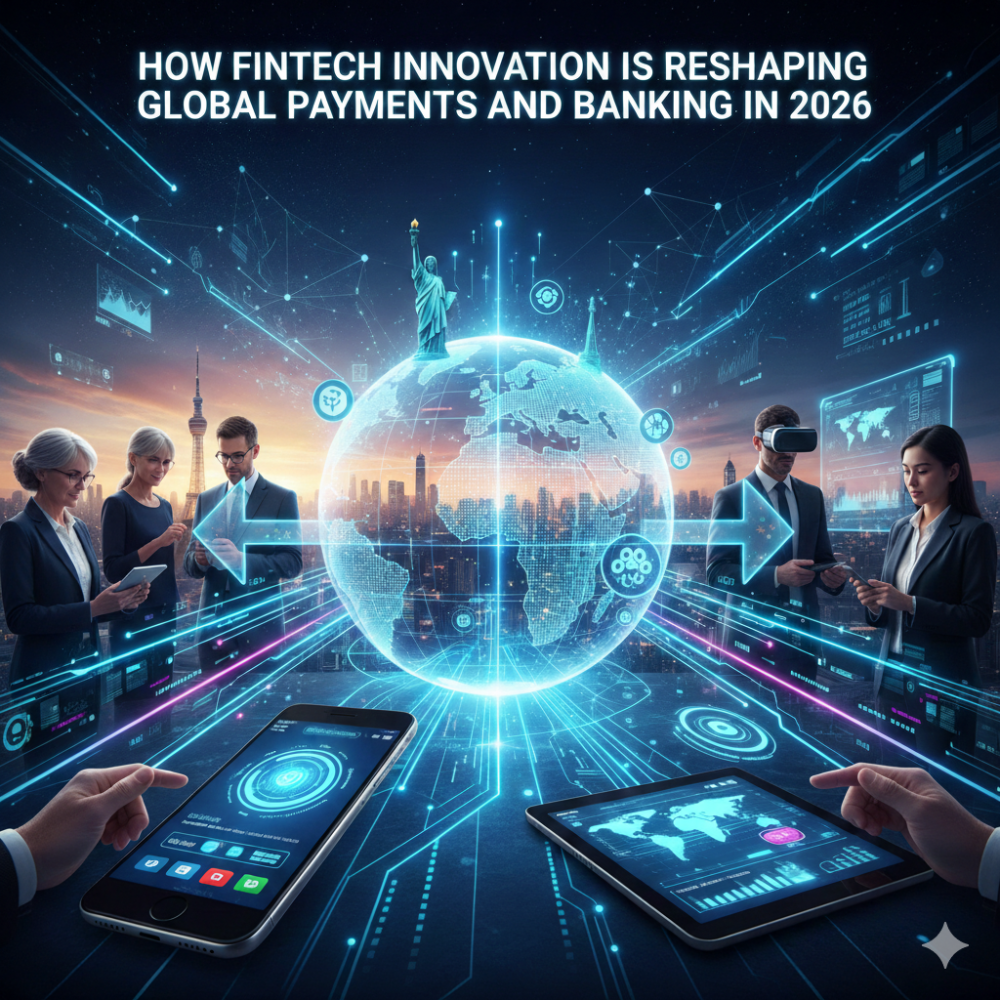
How Fintech Innovation Is Reshaping Global Payments and Banking in 2026
The Fintech 2026: It is Not the Future, It is the Present.
Fintech is not the future of finance in 2026. It has become finance itself. What started as a trend of startups and challenged the traditional banks has now evolved into a worldwide shift of the way money travels, the way banking operates, and the method of establishing trust in the digital economy. The payment process is accelerated, banking is becoming invisible, compliance is being automated, and financial services are now being integrated into applications and platforms that were never intended to be financial institutions. Whether fintech will disrupt the banking industry is no longer a question. The actual question of 2026 is: what is even banking at this point anymore?
The Payments Revolution: Money Has Somewhere Lost Its Viscosity
Fintech has fundamentally transformed how money moves across borders. For decades, international payments were slow, expensive, and dependent on outdated, pre-Internet banking infrastructure, where manual Proof of Address checks added unnecessary friction. Today, that legacy system is being replaced by modern digital payment rails and automated address verification technologies. As fintech matures, money is beginning to move the way information does, instantly and globally supported by faster, digital Proof of Address processes. Consumers now expect speed and simplicity in financial services, while businesses benefit from smoother onboarding, faster settlement, and better liquidity. By 2026, real-time, borderless payments enabled by digital identity and Proof of Address verification will be the norm rather than the exception.
Key developments include:
- International payments and remittances are shifting from slow, bank-centric systems to real-time digital rails
- Legacy processes involving multiple verification and settlement steps are being streamlined
- Fintech platforms are reducing intermediaries, lowering fees, and accelerating cross-border transactions
- Payments for subscriptions, invoices, and remittances are becoming instant and frictionless
- Consumers now expect mobile-first, wallet-based, real-time payment experiences
- Businesses benefit from improved cash flow, faster settlement, and lower operational costs
- Faster payments enable companies to scale internationally without heavy reliance on traditional banks
Real-Time Payments Are The New Standard.
In most markets, real-time payments are rapidly becoming the standard rather than a differentiator. Consumers increasingly expect transfers to settle instantly, whether sending money to friends, paying businesses, or completing online purchases. This shift is driven by digital-first lifestyles shaped by instant communication and on-demand commerce. Governments and central banks are responding by investing heavily in modern payment rails to replace aging clearing systems. These upgrades aim to improve efficiency while expanding financial inclusion through wider access to digital payments. Fintech companies, in turn, are building intuitive, mobile-first experiences on top of this infrastructure. By 2026, speed is no longer a competitive advantage in payments; it is simply the baseline expectation.
Key developments include:
- Real-time payments are becoming the default across consumer, retail, and business transactions
- Instant settlement is now expected for peer-to-peer transfers, online purchases, and bill payments
- Governments and central banks are modernizing national payment infrastructure to reduce reliance on legacy systems
- Faster payment rails support broader financial inclusion by expanding access to digital transactions
- Fintech platforms enhance these rails with user-friendly apps and embedded payment experiences
- Waiting days for settlement is increasingly viewed as outdated and unacceptable
- Merchants benefit from faster access to funds and improved cash flow
- Financial institutions are increasingly relying on document verification to authenticate customer identities and prevent fraud during onboarding.
The Redefining of Cross-border Transactions.
In 2026, cross-border payments will experience a significant change. The current international transactions were fast, costly, and transparent, and they might have been subjected to many banks, concealed charges, and also took a long time to be processed. The frictions are decreasing with the use of Fintech innovations, and businesses and individuals are finding it easier, cheaper, and more transparent to transfer money across borders. For instance, platforms like RemitFinder help you compare various providers to find the best exchange rate to send money from Canada to Pakistan or any other country, ensuring you benefit from these modern efficiencies. This evolution in digital finance empowers users with more control and better value than ever before.
Key developments include:
Intelligent routing algorithms: AI and algorithms determine the most efficient and quickest routes between locations.
- Settlement using blockchains: Distributed ledgers can be used to facilitate almost instant clearing without the assistance of several intermediaries.
- Stablecoin remittances: Remittances in digital form allow a stable value transfer with fewer charges.
- Greater transparency: The user will be able to see the transactions almost in real-time and know the precise costs and settlement periods.
- Improved accessibility: Mobile-first means that people and small businesses can send and receive money all over the world.
- Big corporations are not the only beneficiaries of these innovations but also the migrant workers and small business owners, who are providing an ecosystem of global payments that is more inclusive and efficient.
The use of Digital Wallets and Embedded Finance is altering consumer behavior
The emergence of embedded finance and digital wallets is another significant force that is changing payments. Consumers in most areas no longer think of bank transfers or card payments. They just need to tap, scan, or click in the apps they use regularly as a matter of fact, and anticipate a seamless and immediate transaction.
Digital wallets have ceased to be a convenience and are now at the center of daily financial transactions, especially in emerging markets, with mobile-first usage being faster than traditional banking infrastructures. Whether it is the payment of groceries and utility bills, or even remittances or half a ride, digital wallets are becoming the most important way that people engage with money.
Simultaneously, embedded finance is making it possible to dramatically change the way financial services are provided. Marketplaces of e-commerce, ride-hailing apps, social networks, and even game worlds now have the capability of adding banking, payment and lending functionalities directly into their user experience.
This will enable the user to use credit, shop, or store money without having to leave the site that they are already interacting with. Embedded finance will not only make transactions easier but will foster more financial activity by eliminating the requirement to use different banking apps, which will generate new sources of revenue on platforms and new points of access to underserved groups.
This intersection of digital wallets and embedded finance is reconstructing the concept of banking. Rather than a separate service, a financial activity is turning into an undetected layer installed into every life, allowing quicker transactions, enhanced financial access, and tailored functions. The consumers are getting convenience and speed, businesses are getting increased transaction volumes and greater engagement, and fintech innovation has continued to blur the boundaries between technology, commerce and finance.
See also: Powering Industrial Progress with Advanced Motor Technology
Banking Is Moving Modular, Not Monolithic.
This development itself is transforming banking. The way traditional banks used to be was that deposits, lending, payments, and investments were all put under the same roof. Banking in 2026 is becoming more and more modular. Fintech firms have disaggregated financial services and recreated them as API-driven elements, which can be integrated into digital platforms.
Banking-as-a-Service offerings enable non-financial companies to provide accounting, card, or credit services without becoming full-fledged banks.
Challenger Platforms and Neobanks Are Still on the Increase.
Neobanks and pure digital challengers have also been on the increase. They are not just successful due to reduced charges or advanced design, but it is a more profound change in customer expectations. Consumers desire financial services that are easy to use, tailored, and offered instantly.
Experiences created by Neobanks are more technology products and less like a traditional bank, with real-time analytics, automated budgeting tools, and quicker onboarding processes.
Financial decision-making is undergoing change with the help of artificial intelligence.
By 2026, artificial intelligence will have emerged as one of the most revolutionary agents in fintech. Growth in customer service:AI is transforming AI in Customer Service in the area of conversational banking assistants and predictive bank recommendations.
It is also transforming the credit underwriting into making lenders evaluate risk through alternative data other than the conventional credit histories. This has increased access to finance for individuals and small businesses who had hitherto not been able to get access to formal lending programs.
Automated Compliance and RegTech Are Becoming Necessary.
Fintech innovation has also changed compliance and regulation. Regulatory technology, also known as RegTech, is assisting financial institutions in automating identity verification, conducting real-time transaction monitoring, and verifying KYC documents to meet increasingly strict AML and fraud-prevention requirements.
Rather than compliance being slow and manual, it is becoming more scalable and flexible through the automation achieved through fintech.
Blockchain and Digital Assets Are Leaving the Hype.
Blockchain and digital assets will continue to play an important role in the fintech industry in 2026, albeit with a more realistic infrastructure, rather than speculative hype.
Stablecoins are also being attempted as a settlement tool, and tokenization is enabling real assets like bonds, securities, or even property to be digitized. Concurrently, central banks worldwide are still piloting and executing central bank digital currencies, expecting to digitalize monetary systems and guarantee sovereign oversight of digital currency.
The Role that Fintech Plays in Financial Inclusion is Growing Around the World
Financial inclusion has been, perhaps, one of the most significant effects of fintech. Millions of people in the financial systems of many developing economies have been introduced to fintech with mobile wallets, digital lending, and easy onboarding.
The availability of credit, savings facilities, and online payments has allowed entrepreneurs and small businesses to be more active in the world economy.
The largest challenges are cybersecurity and Trust.
Nevertheless, the rapid development of fintech is associated with new challenges as well. Fraudsters develop tactics based on AI, and their methods of cybersecurity infiltration include deepfake impersonation and synthetic identity fraud.
Trust and security are becoming even more important as financial services are becoming more digital. Biometric authentication, behavioral analytics, and robust identity verification structures are some of the ways the industry is responding.
Regulation 2026: Finding a middle ground between Innovation and Protection.
The 2026 regulation is walking a fine line in its endeavor to promote innovation and to avoid systemic risk. Policymakers all over the globe acknowledge that fintech can lead to the development of any economy, enhance financial inclusion, and innovate payments, yet they have to address the issue of consumer protection and financial stability. Consequently, regulators are becoming more proactive, as opposed to reactive. Examples of such environments include sandbox environments where fintech startups can test new products and services in a controlled environment and then scale to a broader market.
More distinct licensing frameworks are being adopted in order to determine ambiguity as to what rules apply to new financial models, ranging from neobanks to online lending systems. More robust consumer protection frameworks are also prioritized, as the users can be educated on charges, risks, and information privacy, and enjoy innovative financial services.
The financial technology industry is not in a regulatory grey area anymore; it is now being incorporated into the official financial system. Governments have been working with fintech to come up with guidelines that will balance innovation and control.
The cross-border regulation is gaining momentum, specifically, anti-money laundering (AML), know-your-customer (KYC) regulations, and digital identity authentication, to make sure that the global transactions are safe and transparent. Simply put, regulation in 2026 is becoming more of a collaborative relationship in enhancing fintech development, which creates the environment in which technology can be advanced without jeopardising financial integrity.
Summary: Fintech Is Restructuring the Financial System Internally.
Fintech innovation in 2026 is not only transforming payments and banking – it is transforming the structure of the world economy. Financial services are being made quicker, more integrated, smarter, and more inclusive.
There is a blurring of the conventional divisions between banks, technology corporations, merchants, and platforms. The future of banking might not be determined by physical branches or even banking apps as we continue to look into the future. Rather, it will be characterized by ecosystems, invisible finance, real-time trust, and digital identity.
Fintech is no longer threatening the financial world in the external world. It is taking it back to its core.